Category:Memory
Duration:~15 minutes
Ages:18+
Populations:adults, research, clinical
Parameters:9 configurable parameters: feedbacktimeout (1500ms), distractfile (distraction.csv), batterythreshold (0.85), batteryFeedback (1), distracttimeoutminimum (1000ms), distracttimeoutmultiplier (2.5), requirethresholdprebattery (1), allowsecondchance (0), responsemode (none), testreps (3), testminsize (3), testmaxsize (7)
Version:2.4
Description
Complex working memory span task requiring participants to remember letters while judging whether sentences make sense.
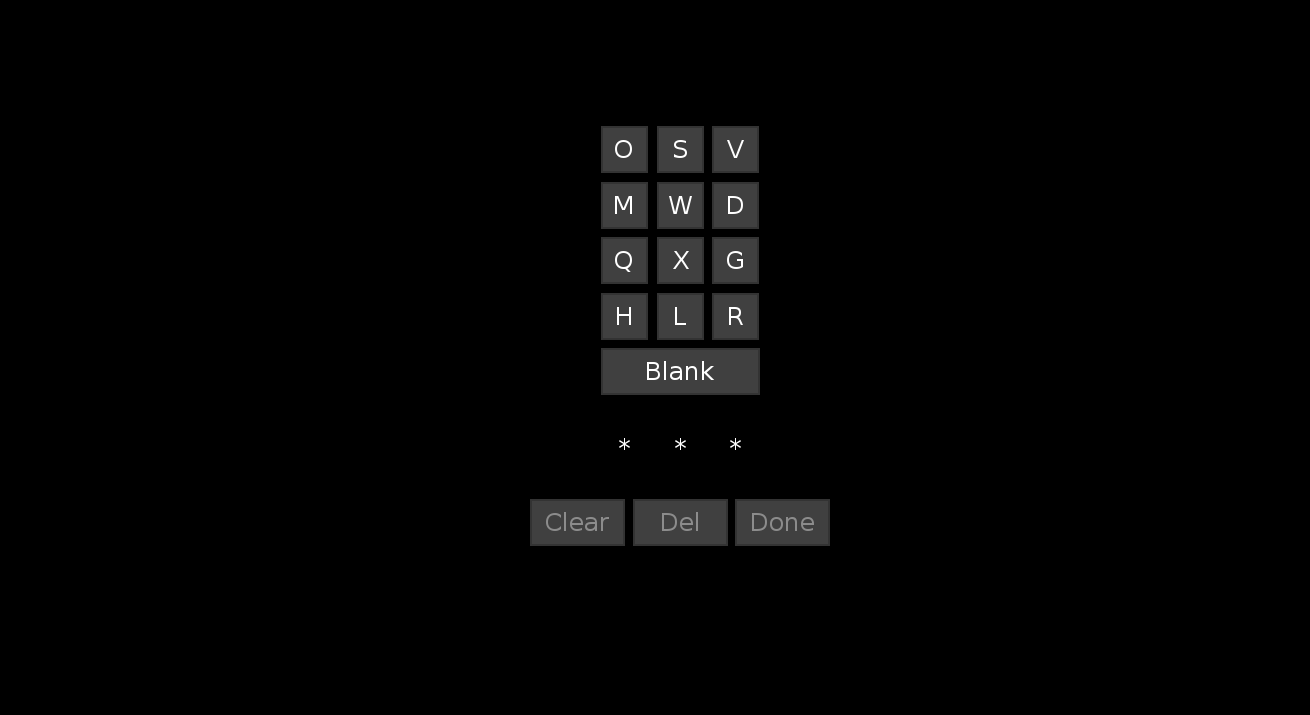
Participants read sentences and judge whether they make sense (True/False), then see a letter to remember. After a series of sentence-letter pairs (set size 3-7), they recall the letters in order by clicking on a grid of 12 possible letters. The task includes practice blocks for letter recall only, sentence judgments only, and combined trials. Sentence processing performance is monitored and participants must maintain 85% accuracy on sentence judgments to ensure divided attention. The main test consists of sets of 3 trials at each set size (3, 4, 5, 6, 7) in random order. Sentence reading time is calculated adaptively based on practice performance.
Measures: Verbal working memory span, reading comprehension, executive function, dual-task processing
Notes
- Task follows Daneman & Carpenter (1980) original methodology with Unsworth et al. (2009) automated modifications
- Sentence accuracy threshold (default 85%) enforced to ensure divided attention
- Adaptive sentence timeout calculated from practice: mean + 2.5*SD with 1000ms minimum
- Practice includes: letter recall only (3 trials at size 2-3), sentence judgments only (15 trials), combined (3 trials at size 2)
- Main test: 15 trials total with set sizes [3,4,5,6,7] × 3 repetitions in randomized order
- Sentences presented at 40pt font size, letters presented at 80pt font size
- Sentence stimuli loaded from distraction.csv file (true/false sentences)
- Letter recall uses grid with 12 possible letters and Clear/Del/Blank/Done buttons
- Real-time accuracy display shown in test phase (top right corner)
- Trial counter shows current trial / total trials during test phase
- Supports LSL markers for electrophysiological recording integration
- Supports online upload via InitializeUpload() and UploadFile()
- Uses HTML-lite formatted text with adaptive textboxes for instructions
- Includes 7 translations (en, es, de, pt, fr, nl, it) via JSON translation system
- Practice cannot be repeated - stricter than ospan/symmetryspan (allowsecondchance=0)
- Creates HTML report summarizing performance metrics and set size analysis
Example Data Output (5 sample rows)
| subnum | trial | probtime | memtime | length | numstim | stim | resp | memcorr | time | distcorr | numcorrdist | totnumdist | runningcorrect | runningtotal |
|---|
| example | 1 | -1 | 1000 | 2 | 3 | I|W | I|W | 1 | -1 | -1 | 0 | 0 | 0 | 0 |
| example | 2 | -1 | 1000 | 3 | 5 | I|T|Z | I|T|Z | 1 | -1 | -1 | 0 | 0 | 0 | 0 |
| example | 3 | -1 | 0 | 0 | 1 | | | NA | 1323 | 1 | 1 | 1 | 1 | 1 |
| example | 4 | -1 | 0 | 0 | 1 | | | NA | 1547 | 1 | 2 | 2 | 3 | 3 |
| example | 5 | -1 | 0 | 0 | 1 | | | NA | 1503 | 1 | 2 | 2 | 5 | 5 |
References
Daneman, M., & Carpenter, P. A. (1980). Individual differences in working memory and reading. Journal of Verbal Learning and Verbal Behavior, 19(4), 450-466.
Unsworth, N., Redick, T. S., Heitz, R. P., Broadway, J. M., & Engle, R. W. (2009). Complex working memory span tasks and higher-order cognition: A latent-variable analysis of the relationship between processing and storage. Memory, 17(6), 635-654.