PEBL Hub — IRB Fact Sheet — 2026-10-07
Time-Tapping Task
Motor Function
Timing
Psychomotor Speed
Category:Motor
Duration:~10 minutes
Version:1.0
Description
Motor timing task measuring self-paced tapping consistency across multiple trials
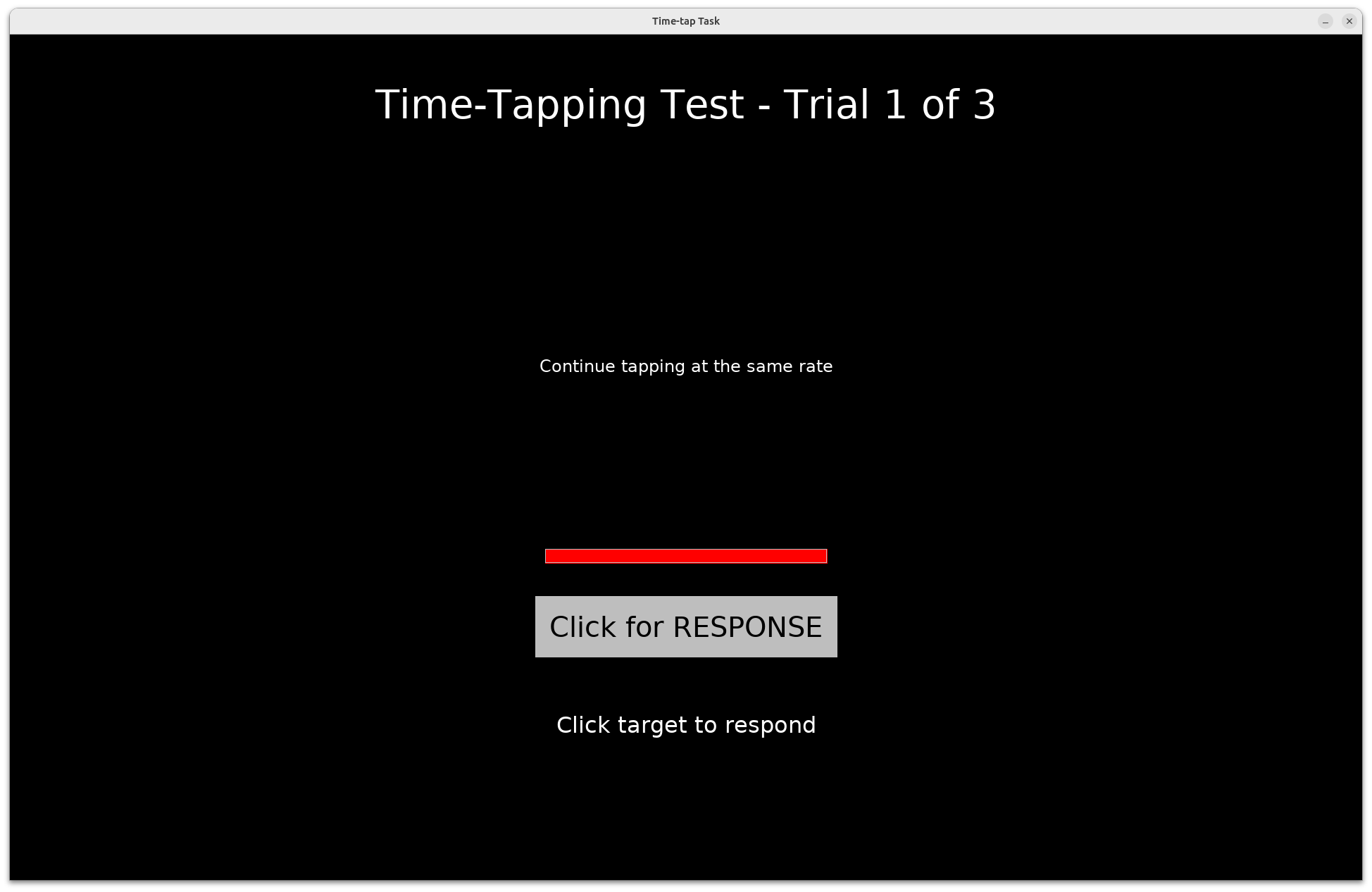
Participants tap at a self-paced even rate following a visual entrainment period. After seeing a flashing cross that demonstrates the target tapping rate, participants must maintain that rhythm for a sustained period (default 180 seconds per trial). The task assesses low-level motor timing ability and may be sensitive to fatigue, sleep deprivation, and motor control deficits.
Measures: Motor timing consistency, rhythm maintenance, psychomotor speed, sustained motor control
Notes
- Ensure participants understand they should maintain a steady rhythm throughout each trial, not just tap as fast as possible. The entrainment period helps establish the target rhythm before the test phase begins.
- Consistency is measured by variability in inter-tap intervals. Lower variability indicates better motor timing control. Compare actual intervals to target intervals to assess accuracy.
- Poor performance (high variability or deviation from target) may indicate fatigue, sleep deprivation, motor control deficits, or medication effects. Performance typically degrades with longer trial durations.
- Sensitive to fatigue states, sleep deprivation, medication effects, and motor disorders. Part of UTC-PAB used for operational readiness assessment.
Scoring & Interpretation
| Validation | Part of UTC-PAB (Unified Tri-Services Cognitive Performance Assessment Battery), Test 19 |
References
Mueller, S. T., & Piper, B. J. (2014). The Psychology Experiment Building Language (PEBL) and PEBL Test Battery. Journal of Neuroscience Methods, 222, 250-259.