PEBL Hub — IRB Fact Sheet — 2026-10-07
Muller-Lyer Illusion Task
Perception
Category:Perception
Duration:~5 minutes
Parameters:9 configurable parameters available
Version:1.0
Description
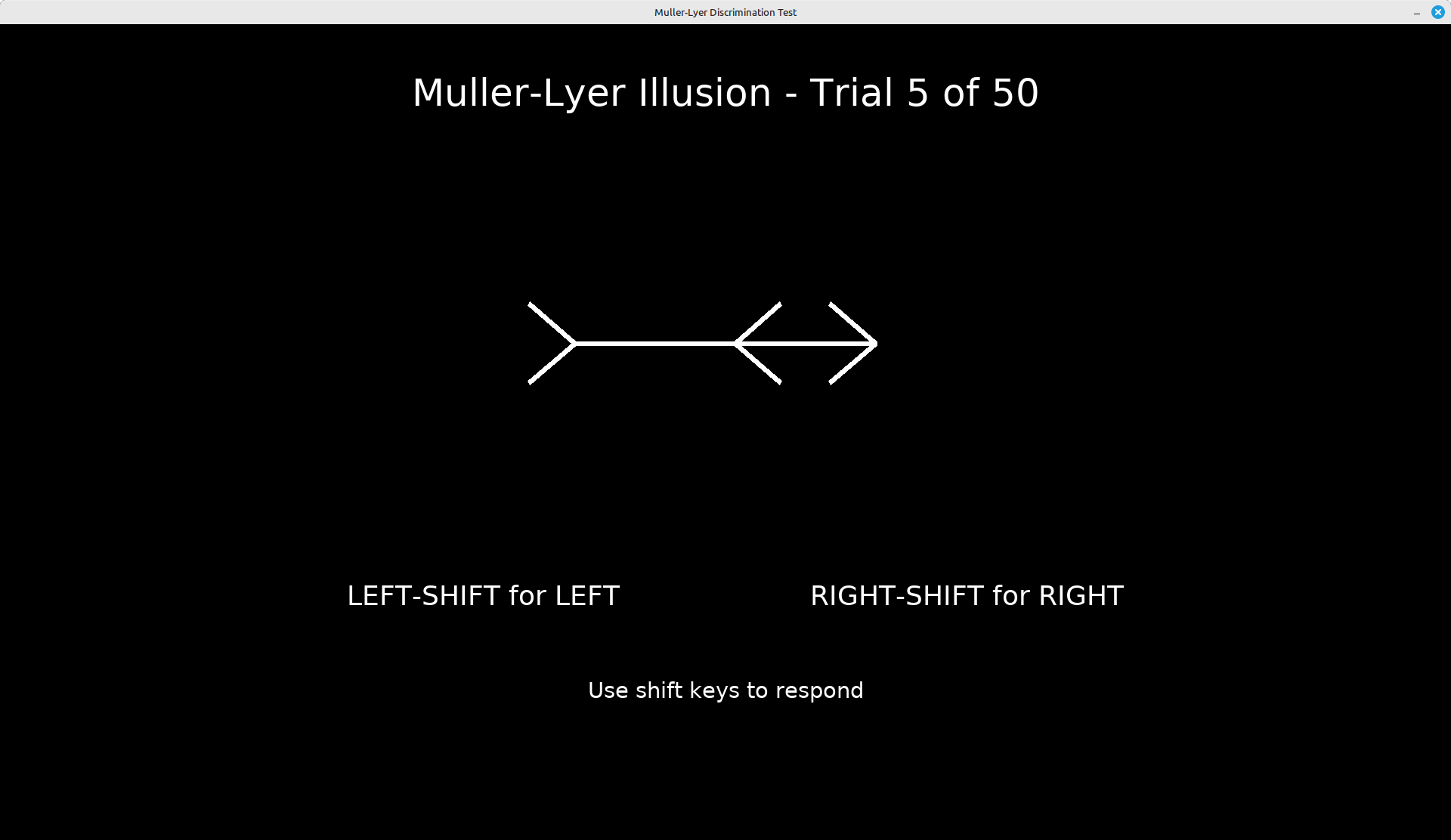
Psychometric study of the classic Muller-Lyer illusion using an adaptive staircase to find the point of subjective equality.
A horizontal line with arrowheads is displayed briefly. A central set of arrowheads divides the line into two segments. Participants judge which segment is longer (left or right). An adaptive staircase adjusts the difference between segments to converge on the participant's point of subjective equality — the offset at which both segments appear equal in length.
Measures: Susceptibility to the Muller-Lyer illusion, perceptual judgment accuracy
Key Parameters
| prestime | how long to do the presentation, in ms (default: 400) |
| trials | Number of trials (default: 50) |
| spread | How many pixels left and right of the centerline will the stimuli be (default: 125) |
| giveFeedback | whether feedback should be given (default: 0) |
| stepsize | How big of a step to make after judgement? (default: 10) |
| randomstep | How much randomness to include in step? (default: 16) |
| diff | start diff value. It should be somewhat negative. (default: -40) |
| responsemode | Response method for left/right judgment (default: auto) |
| responselabels | Semantic labels for left and right responses (default: Array) |
Example Data Output (5 sample rows)
| subnum | trial | diff | resp | corr | abstime | rt |
|---|---|---|---|---|---|---|
| example | 1 | -57 | left | 0 | 7914 | 1675 |
| example | 2 | -55 | right | 1 | 10344 | 705 |
| example | 3 | -51 | right | 1 | 11807 | 755 |
| example | 4 | -41 | right | 1 | 13318 | 791 |
| example | 5 | -49 | left | 0 | 14866 | 644 |
References
Muller-Lyer, F. C. (1889). Optische Urteilstauschungen. Archiv fur Anatomie und Physiologie, Physiologische Abteilung, 2, 263-270.
Mueller, S. T. (2011). The PEBL Muller-Lyer Illusion Task. Computer software retrieved from http://pebl.sf.net/battery.html