Muller-Lyer Illusion Task
Description
Psychometric study of the classic Muller-Lyer illusion using an adaptive staircase to find the point of subjective equality.
Measures: Susceptibility to the Muller-Lyer illusion, perceptual judgment accuracy
Perception
About This Test
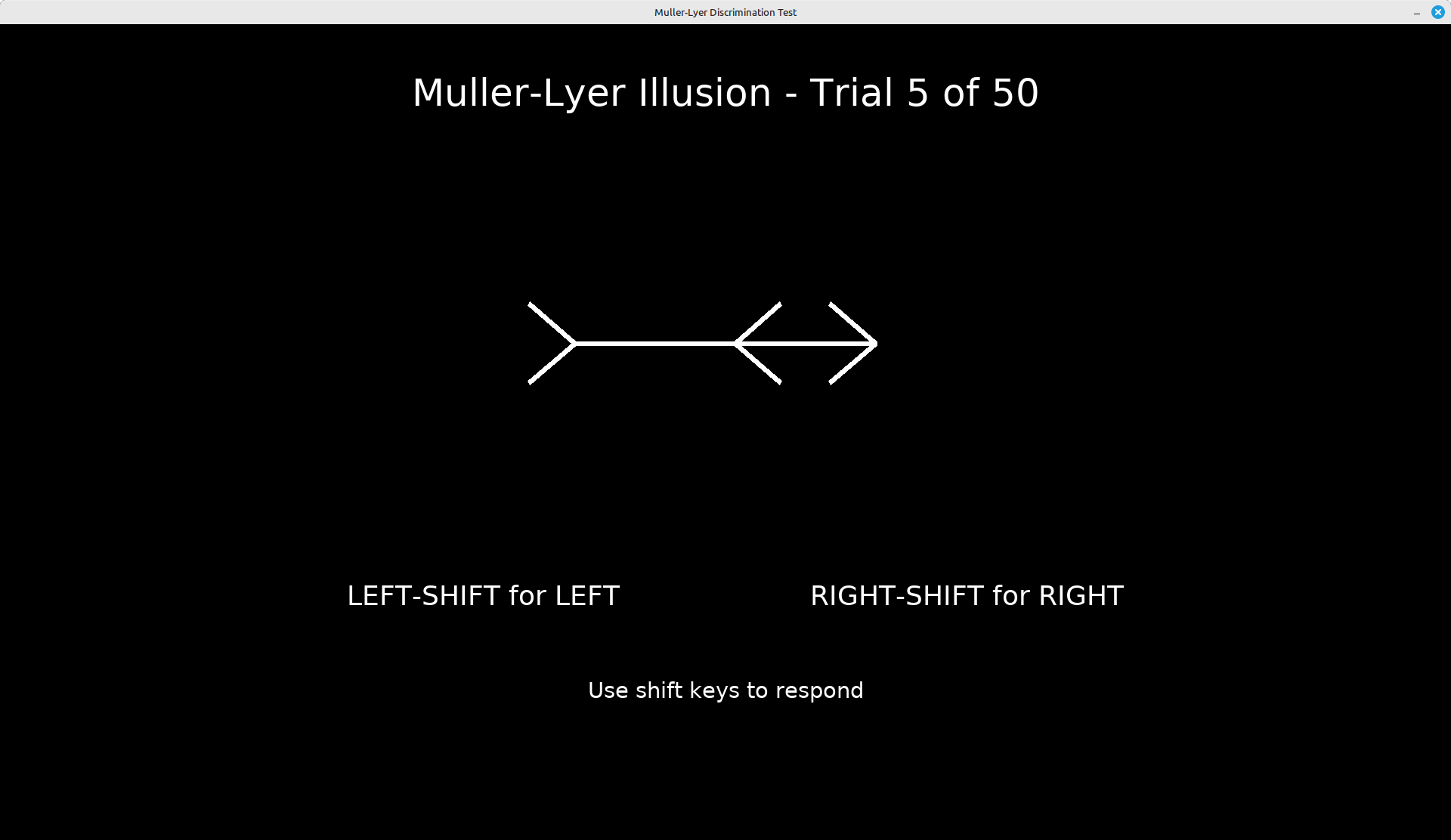
A horizontal line with arrowheads is displayed briefly. A central set of arrowheads divides the line into two segments. Participants judge which segment is longer (left or right). An adaptive staircase adjusts the difference between segments to converge on the participant's point of subjective equality — the offset at which both segments appear equal in length.
Test Details
mullerlyermullerlyer.pbl🚀 Try Without Registration
Run this test immediately without creating an account. Data stays in your browser.
Researcher Access Benefits
To save configurations, upload data, use translations, track completion, and manage studies, please log in or register for an account.
Scientific Background
Original Task References:
These references describe the original task that this PEBL implementation is based on.
- Muller-Lyer, F. C. (1889). Optische Urteilstauschungen. Archiv fur Anatomie und Physiologie, Physiologische Abteilung, 2, 263-270.
PEBL-Specific References:
These studies used the PEBL version of this task.
- Mueller, S. T. (2011). The PEBL Muller-Lyer Illusion Task. Computer software retrieved from http://pebl.sf.net/battery.html
Data Output
The task produces a trial-by-trial CSV file. The position of the middle arrowhead is an adaptive threshold, adjusted trial-by-trial to converge on 50% accuracy (the point of subjective equality). The key outcome is the mean threshold from the last half of trials. A negative threshold indicates the participant perceives the left segment as longer when it is actually shorter — the expected direction of the Muller-Lyer illusion, where inward-pointing arrows make a segment appear longer. A threshold near zero indicates little susceptibility to the illusion.
mullerlyer-{subnum}.csv
Example Data
| subnum | trial | diff | resp | corr | abstime | rt |
|---|---|---|---|---|---|---|
| example | 1 | -57 | left | 0 | 7914 | 1675 |
| example | 2 | -55 | right | 1 | 10344 | 705 |
| example | 3 | -51 | right | 1 | 11807 | 755 |
| example | 4 | -41 | right | 1 | 13318 | 791 |
| example | 5 | -49 | left | 0 | 14866 | 644 |
| example | 6 | -35 | right | 1 | 16266 | 676 |
| example | 7 | -41 | left | 0 | 17712 | 783 |
| example | 8 | -51 | left | 0 | 19252 | 848 |
| example | 9 | -35 | right | 1 | 20858 | 793 |
Sample data showing typical output format. Actual values will vary by participant.
About This Test
Psychometric study of the classic Muller-Lyer illusion using an adaptive staircase to find the point of subjective equality.
Category: Perception
Estimated Duration: 5 minutes
Available Translations: 7 languages
Documentation Status: Complete