Tracking Task
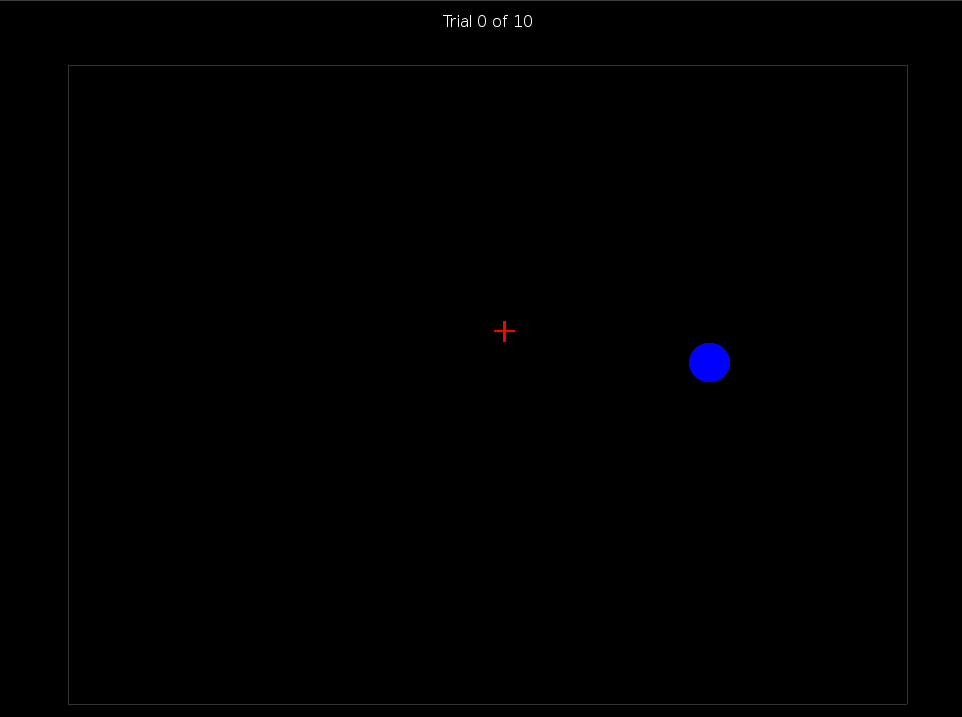
Continuous mouse tracking task measuring visuomotor coordination and sensorimotor adaptation with axis reversal (default configuration)
The PEBL Tracking Task assesses continuous visuomotor control by requiring participants to keep their mouse cursor aligned with a moving target across multiple trials. **Task Structure**: Participants view a white cursor and a moving red target circle. The target follows a pre-programmed trajectory (figure-8, circle, or random path). Participants must continuously adjust their mouse position to keep the cursor as close as possible to the moving target. **Adaptation Manipulation**: By default, this task includes both horizontal and vertical axis reversal (xtrans=-1, ytrans=-1), creating a challenging sensorimotor perturbation where moving the mouse right causes the cursor to move left, and moving down causes the cursor to move up. This tests participants' ability to adapt to novel visuomotor transformations, similar to prism adaptation paradigms. The axis reversal parameters can be modified to test normal mapping or single-axis reversals. **Trial Types**: Each trial lasts a fixed duration (default 30 seconds). The task typically runs 10 trials by default, allowing observation of sensorimotor adaptation across repeated exposure to the reversed mapping. **Related Task**: For discrete pointing movements with similar axis reversal manipulations, see the Move-to-Target Task (movetotarget). The two tasks complement each other by assessing continuous vs. discrete visuomotor control under perturbation. **Administration Time**: 5-10 minutes depending on number of trials **Theoretical Basis**: Continuous tracking tasks measure the integration of visual feedback with motor control systems. Axis reversal manipulations specifically target visuomotor adaptation mechanisms, revealing how the brain recalibrates internal models when sensory-motor mappings are perturbed. Performance improvement across reversed trials demonstrates adaptive learning. **Use Cases**: Motor control research, visuomotor adaptation studies, sensorimotor learning experiments, coordination assessment, neurological screening for motor deficits.
Device requirements: Desktop or laptop with mouse. Touch input not recommended. Screen size 1024x768 or larger.
| trialtime | Time of trial, in seconds (default: 30) |
| numtrials | number of learning trials (default: 10) |
| ytrans | Y translation for learning trials. only considers negative and positive values. (default: -1) |
| xtrans | X translation for learning trials. only considers negative and positive values. (default: -1) |
| movementrate | Movement rate of target, in number of pixels/ms (default: 0.2) |