Tracking Task
Description
Continuous mouse tracking task measuring visuomotor coordination and sensorimotor adaptation with axis reversal (default configuration)
About This Test
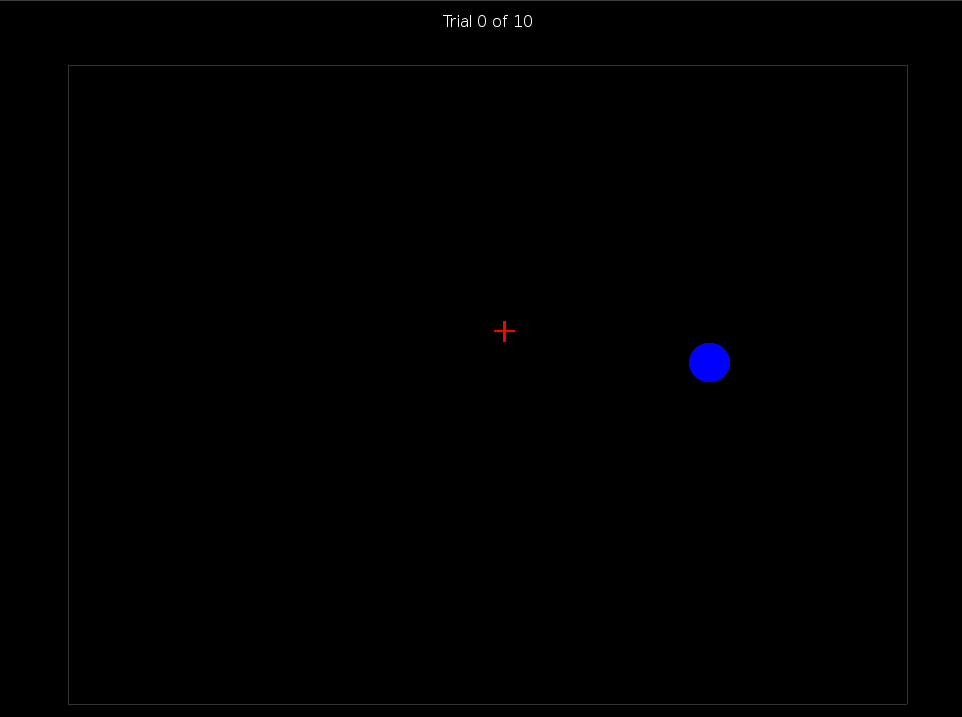
The PEBL Tracking Task assesses continuous visuomotor control by requiring participants to keep their mouse cursor aligned with a moving target across multiple trials. **Task Structure**: Participants view a white cursor and a moving red target circle. The target follows a pre-programmed trajectory (figure-8, circle, or random path). Participants must continuously adjust their mouse position to keep the cursor as close as possible to the moving target. **Adaptation Manipulation**: By default, this task includes both horizontal and vertical axis reversal (xtrans=-1, ytrans=-1), creating a challenging sensorimotor perturbation where moving the mouse right causes the cursor to move left, and moving down causes the cursor to move up. This tests participants' ability to adapt to novel visuomotor transformations, similar to prism adaptation paradigms. The axis reversal parameters can be modified to test normal mapping or single-axis reversals. **Trial Types**: Each trial lasts a fixed duration (default 30 seconds). The task typically runs 10 trials by default, allowing observation of sensorimotor adaptation across repeated exposure to the reversed mapping. **Related Task**: For discrete pointing movements with similar axis reversal manipulations, see the Move-to-Target Task (movetotarget). The two tasks complement each other by assessing continuous vs. discrete visuomotor control under perturbation. **Administration Time**: 5-10 minutes depending on number of trials **Theoretical Basis**: Continuous tracking tasks measure the integration of visual feedback with motor control systems. Axis reversal manipulations specifically target visuomotor adaptation mechanisms, revealing how the brain recalibrates internal models when sensory-motor mappings are perturbed. Performance improvement across reversed trials demonstrates adaptive learning. **Use Cases**: Motor control research, visuomotor adaptation studies, sensorimotor learning experiments, coordination assessment, neurological screening for motor deficits.
Test Details
trackingtracking.pbl🚀 Try Without Registration
Run this test immediately without creating an account. Data stays in your browser.
Researcher Access Benefits
To save configurations, upload data, use translations, track completion, and manage studies, please log in or register for an account.
Scientific Background
Original Task References:
These references describe the original task that this PEBL implementation is based on.
- Poulton, E. C. (1974). Tracking skill and manual control. Academic Press.
- Krakauer, J. W. (2009). Motor learning and consolidation: The case of visuomotor rotation. Progress in Motor Control, 405-421.
- Redding, G. M., & Wallace, B. (1996). Adaptive spatial alignment and strategic perceptual-motor control. Journal of Experimental Psychology: Human Perception and Performance, 22(2), 379.
Validation status: Tracking tasks are well-established in motor control literature. Axis reversal paradigms are validated sensorimotor adaptation manipulations.
Typical Use Cases
- Visuomotor adaptation research
- Sensorimotor learning studies
- Motor control assessment
- Cerebellar function testing
- Age-related motor decline research
- Neurological assessment (Parkinson's, cerebellar disorders)
- Skill learning experiments
- Hand-eye coordination measurement