Traveling Salesman Problem Task
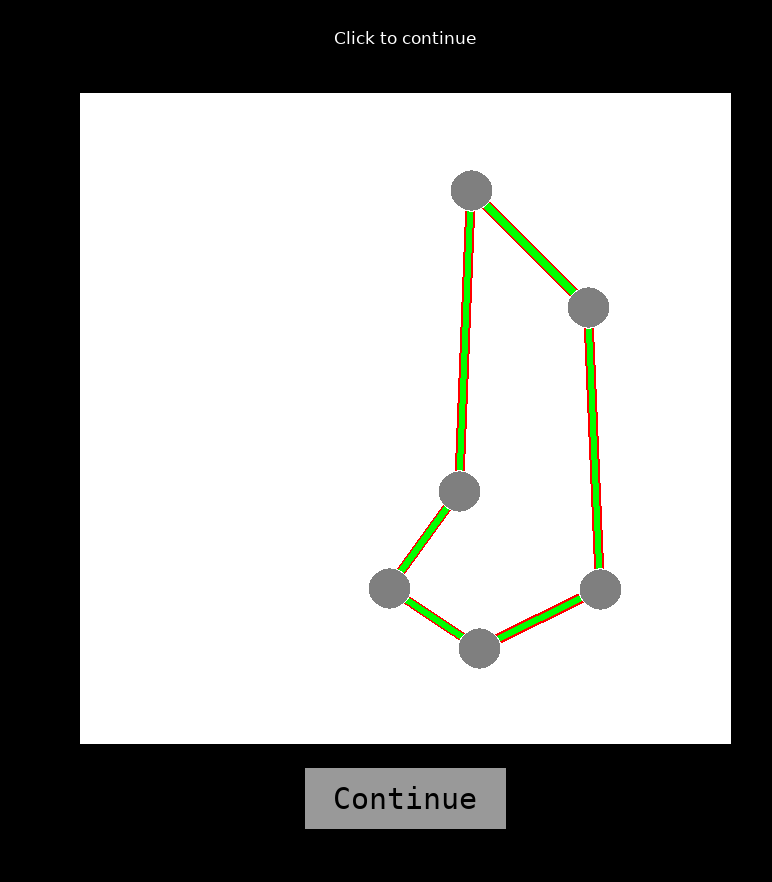
A visual-spatial planning task where participants find the shortest path through a set of points, returning to the starting point, to assess route optimization and spatial reasoning.
Participants view a set of points on the screen and must click through each point exactly once, finding the shortest possible route and returning to the starting grey circle. The task begins with a practice phase (6-point problems) followed by test trials with varying difficulty (10, 20, or 30 points). After completing each route, participants receive feedback showing their path efficiency compared to the optimal solution. Performance is measured by both path efficiency and solution time.
Measures: Spatial planning and reasoning, route optimization ability, visual-spatial problem solving, heuristic decision-making, and the balance between speed and solution quality in complex spatial tasks.
- Migrated to PEBL 2.3 with HTML-lite markup on February 1, 2026
- Supports 10 language translations: English, Spanish, French, German, Italian, Dutch, Portuguese, Chinese, Greek, Turkish
- Default uses subset.csv with pre-selected 15 problems for ~10 minute session
- Includes reliability and normative data (Mueller et al., in submission)
- Tour files can be generated from Concorde TSP solver output using tours/processTSPFile.R
- Additional tour problems available in tours/tours2.zip and tours/TSP.zip
- Supports both click and touch input modes with optional visual/audio feedback
- Backup feature allows participants to undo mistakes (can be disabled)
- Provides immediate efficiency feedback with optimal path visualization
| Validation | in-progress |
| Psychometric data | Available |
| Normative data | Available |