Toulouse N-back Task (TNT)
System Requirements
Minimum: 1280×800
Recommended: 1280×800
Description
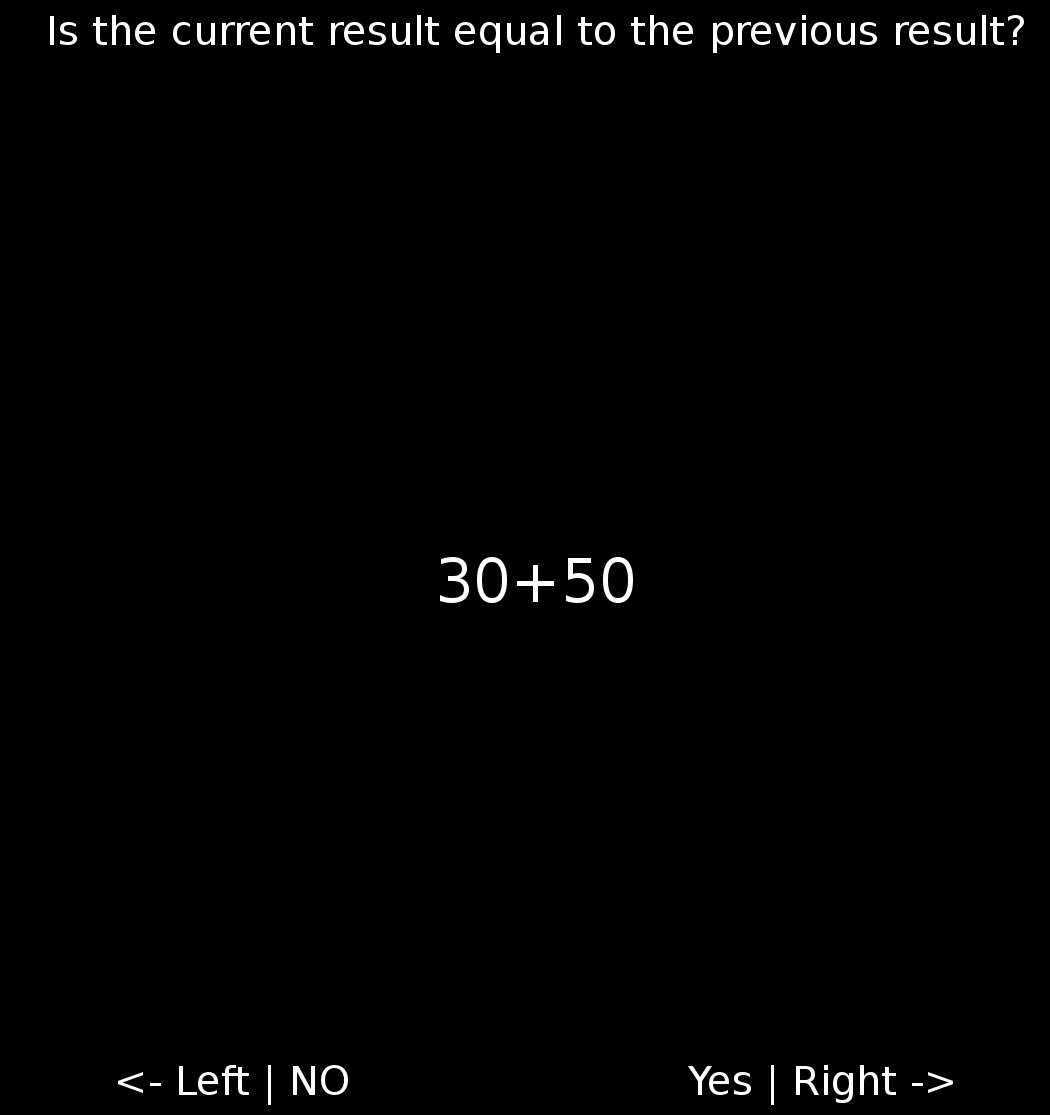
Working memory task that requires participants to monitor and respond to arithmetic problems, comparing current stimuli to those presented n trials back (0-back, 1-back, or 2-back conditions).
Measures: Working memory capacity, executive function, attention, mental arithmetic, n-back performance
working memory executive function attention numerical cognition
Ages: 18+ · Populations: adults, research, clinical
About This Test
Participants view a series of simple arithmetic problems (e.g., '20+30', '95-50') and press the right arrow key when the current problem matches a target (0-back: equals 50; 1-back: same result as previous problem; 2-back: same result as two problems back). Left arrow indicates non-target. The task begins with examples of each condition, then presents 0-back, 1-back, and 2-back blocks in randomized order (2 repetitions each) with rest periods between blocks. Each block contains 12 active stimuli and feedback is provided during training.
- Task includes training examples for each n-back level before the main experiment
- Blocks are presented in random order with 2 repetitions of each condition (0/1/2-back)
- Rest periods (countdown timers) separate active blocks
- Arithmetic problems are pre-generated from fixed stimulus lists to ensure consistency
- Feedback (correct/incorrect/too slow) is provided during training examples only
Test Details
TNTTNT.pbl🚀 Try Without Registration
Run this test immediately without creating an account. Data stays in your browser.
Researcher Access Benefits
To save configurations, upload data, use translations, track completion, and manage studies, please log in or register for an account.
Scientific Background
Original Task References:
These references describe the original task that this PEBL implementation is based on.
- Mandrick, K., Peysakhovich, V., Rémy, F., Lepron, E., & Causse, M. (2016). Neural and psychophysiological correlates of human performance under stress and high mental workload. Biological psychology, 121, 62-73.
PEBL-Specific References:
These studies used the PEBL version of this task.
- Hu M., Mouratille D., Imbert J.-P., & Causse M. (Year unknown). PEBL adaptation of the Toulouse N-back Task. Computer software.
Validation status: Validated · Psychometric data available
Original validation published in Mandrick et al. (2016). This PEBL adaptation maintains the core task structure while adapting for computerized presentation.
Data Output
Creates two data files: (1) TNT-Details-<SUBNUM>.csv with trial-level data including n-back condition, trial number, target status, response, reaction time, and response classification; (2) TNT-Report-<SUBNUM>.txt with block-level summary statistics including accuracy metrics (true/false positives/negatives) and mean reaction times for correct/incorrect responses.
Key Variables
| Variable | Description |
|---|---|
| type | N-back condition: zero (0-back), one (1-back), or two (2-back) |
| target | Target status: 1=target trial (should press right arrow), 0=non-target (should press left arrow or timeout) |
| rT | Reaction time in milliseconds from stimulus onset to response (0 if timeout) |
| resptype | Response classification: true positive (target, correct), false positive (non-target, incorrect), true negative (non-target, correct), false negative (target, incorrect) |
Example Data
example-data-details.csv Primary
Trial-by-trial data with columns: subnum, type (zero/one/two for n-back level), trialnum, target (0=non-target, 1=target), resp (0=left arrow, 1=right arrow), rT (reaction time in ms), resptype (true positive/negative, false positive/negative)
| subnum | type | trialnum | target | resp | rT | resptype |
|---|---|---|---|---|---|---|
| example | zero | 2 | 1 | 0 | 2196 | false negative |
| example | zero | 3 | 0 | 0 | 1547 | true negative |
| example | zero | 4 | 1 | 1 | 824 | true positive |
| example | zero | 5 | 0 | 0 | 1219 | true negative |
| example | zero | 6 | 0 | 0 | 1371 | true negative |
| example | zero | 7 | 0 | 0 | 1247 | true negative |
| example | zero | 8 | 1 | 1 | 1104 | true positive |
| example | zero | 9 | 0 | 0 | 1018 | true negative |
| example | zero | 10 | 0 | 0 | 1003 | true negative |
example-data-report.txt Summary
Summary statistics for each block including: participant number, n-back type, target amount, number of misses, correct/incorrect responses, true/false positives/negatives, mean RT for correct and incorrect responses
Participant number : example
Type : zero-back
Target Amount 4
Number of misses : 0
Number of correct responses : 10
Number of incorrect responses : 2
Number of true positives : 3
Number of true negatives : 7
Number of false positives : 1
Number of false negatives : 1
Mean correct answer response time : 3732.33
Mean incorrect answer response time : 4148
Participant number : example
Type : one-back
Target Amount 4
Number of misses : 0
Number of correct responses : 12
Number of incorrect responses : 0
Number of true positives : 4
Number of true negatives : 8
Number of false positives : 0
Number of false negatives : 0
Mean correct answer response time : 5148
Mean incorrect answer response time : -nan
Participant number : example
Type : zero-back
Target Amount 4
Number of misses : 0
Number of correct responses : 12
Number of incorrect responses : 0
Number of true positives : 4
Number of true negatives : 8
Number of false positives : 0
Number of false negatives : 0
Mean correct answer response time : 3394.5
Mean incorrect answer response time : -nan
Participant number : example
Type : two-back
Target Amount 4
Number of misses : 2
Number of correct responses : 10
Number of incorrect responses : 2
Number of true positives : 3
Number of true negatives : 7
Number of false positives : 1
Number of false negatives : 1
Mean correct answer response time : 5734.67
Mean incorrect answer response time : 2301
Participant number : example
Type : two-back
Sample data showing typical output format. Actual values will vary by participant.
About This Test
Working memory task that requires participants to monitor and respond to arithmetic problems, comparing current stimuli to those presented n trials back (0-back, 1-back, or 2-back conditions).
Category: Memory
Estimated Duration: 15 minutes
Available Translations: 7 languages
Documentation Sources:
Test description file, Test implementation, Parameter schema
Documentation Status: Standard