Affect Grid
System Requirements
Minimum: 1024×768
Recommended: 1280×800
Description
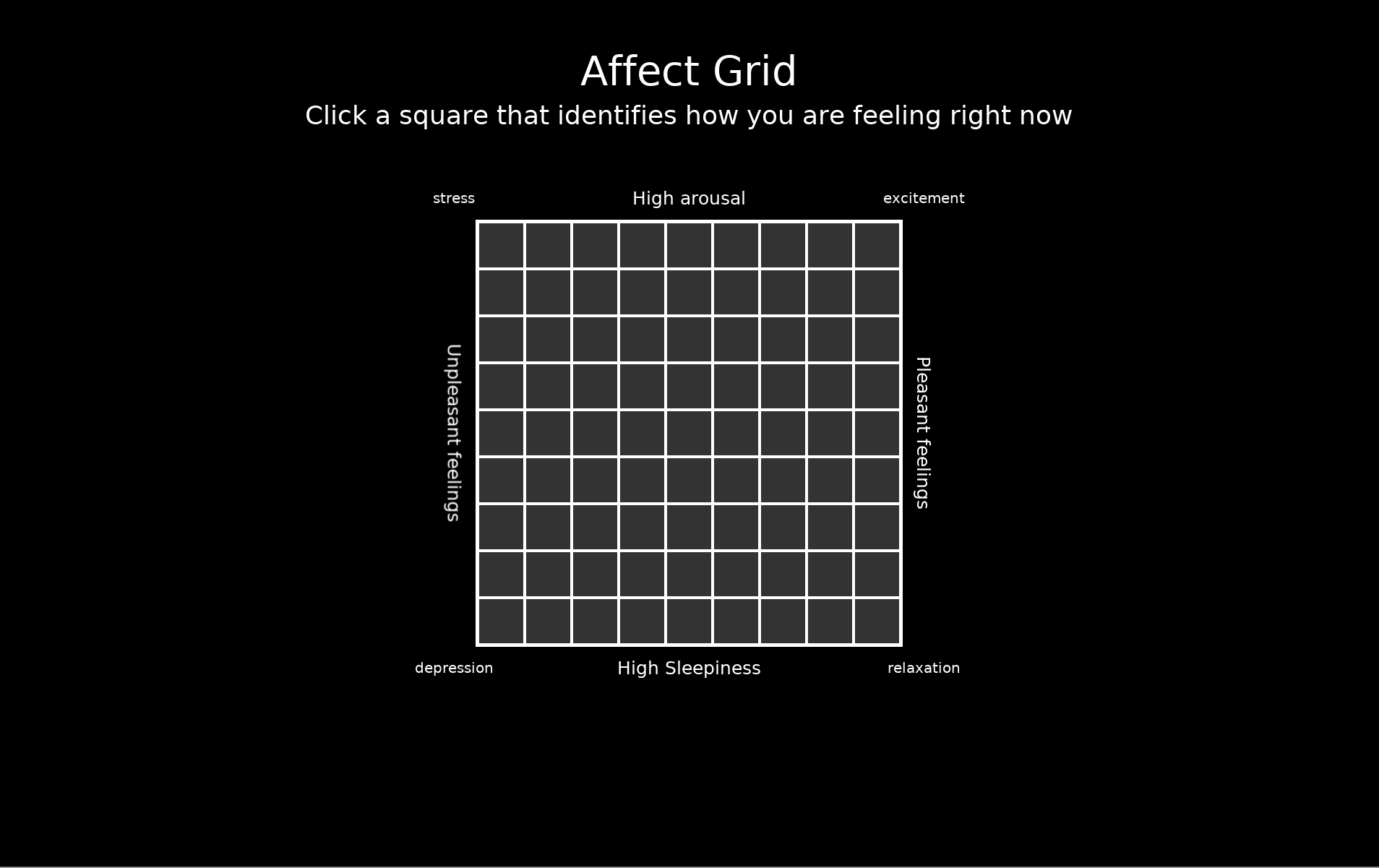
A single-item self-report measure of current emotional state using a 9x9 grid assessing pleasure-displeasure and arousal-sleepiness dimensions
About This Test
The PEBL Affect Grid is a rapid assessment tool for measuring current emotional state along two fundamental dimensions of affect: pleasure-displeasure (valence) and arousal-sleepiness (activation). **Grid Structure**: Participants view a 9x9 grid of clickable squares. The horizontal axis represents pleasure (left = unpleasant feelings, right = pleasant feelings). The vertical axis represents arousal (bottom = high sleepiness, top = high arousal). The four corners are labeled with prototypical emotional states: - Top-left: Stress - Top-right: Excitement - Bottom-left: Depression - Bottom-right: Relaxation **Response Process**: Participants click on a single square that best represents their current emotional state. The selected square is highlighted in red. After making a selection, an 'OK' button appears to confirm the response. Participants can change their selection before confirming. **Administration Time**: Under 1 minute - typically 10-30 seconds per administration. **Theoretical Basis**: The Affect Grid is based on Russell's circumplex model of affect, which posits that all emotional states can be characterized by their position along two independent dimensions: valence (pleasure-displeasure) and activation (arousal-sleepiness). This dimensional approach allows for measurement of the full range of affective states with a single, simple response. **Use Cases**: The brevity and simplicity make it ideal for repeated measurements, experience sampling, pre/post assessments, and situations where minimizing participant burden is critical.
Test Details
affectgridaffectgrid.pbl🚀 Try Without Registration
Run this test immediately without creating an account. Data stays in your browser.
Researcher Access Benefits
To save configurations, upload data, use translations, track completion, and manage studies, please log in or register for an account.
Scientific Background
Original Task References:
These references describe the original task that this PEBL implementation is based on.
- Russell, J. A., Weiss, A., & Mendelsohn, G. A. (1989). Affect Grid: A single-item scale of pleasure and arousal. Journal of Personality and Social Psychology, 57(3), 493-502.
- Russell, J. A. (1980). A circumplex model of affect. Journal of Personality and Social Psychology, 39(6), 1161-1178.
- Russell, J. A., & Barrett, L. F. (1999). Core affect, prototypical emotional episodes, and other things called emotion: Dissecting the elephant. Journal of Personality and Social Psychology, 76(5), 805-819.
- Barrett, L. F., & Russell, J. A. (1998). Independence and bipolarity in the structure of current affect. Journal of Personality and Social Psychology, 74(4), 967-984.
- Killgore, W. D. (1998). The Affect Grid: A moderately valid, nonspecific measure of pleasure and arousal. Psychological Reports, 83(2), 639-642.
Validation status: The original Affect Grid (Russell et al., 1989) demonstrated good convergent validity with longer mood measures, test-retest reliability, and sensitivity to mood manipulations. The single-item format shows correlations with multi-item scales measuring pleasure (r=0.87 with PANAS Positive Affect) and arousal (r=0.75 with Thayer Activation scale). The grid format has been validated in numerous studies and translated into multiple languages.
Typical Use Cases
- Experience sampling and ecological momentary assessment
- Pre/post intervention mood measurement
- Repeated measurements during experimental tasks
- Affective response to stimuli (images, videos, sounds, etc.)
- Real-time mood tracking in field studies
- Brief mood assessment in clinical or therapeutic settings
- Emotion regulation studies
- Stress and relaxation research
- User experience and product evaluation
- Physiological stress studies requiring minimal response burden