Digit-Symbol Substitution Test
System Requirements
Minimum: 1024×768
Recommended: 1280×800
Description
A processing speed and associative learning task requiring participants to match symbols with digits or letters with digits using a mapping key displayed on screen.
Measures: Processing speed, visual scanning, sustained attention, working memory, and symbol-digit paired-associate learning ability.
Processing Speed Working Memory Attention
Ages: 7+ · Populations: adults, children, research, clinical, neuropsychological-assessment
About This Test
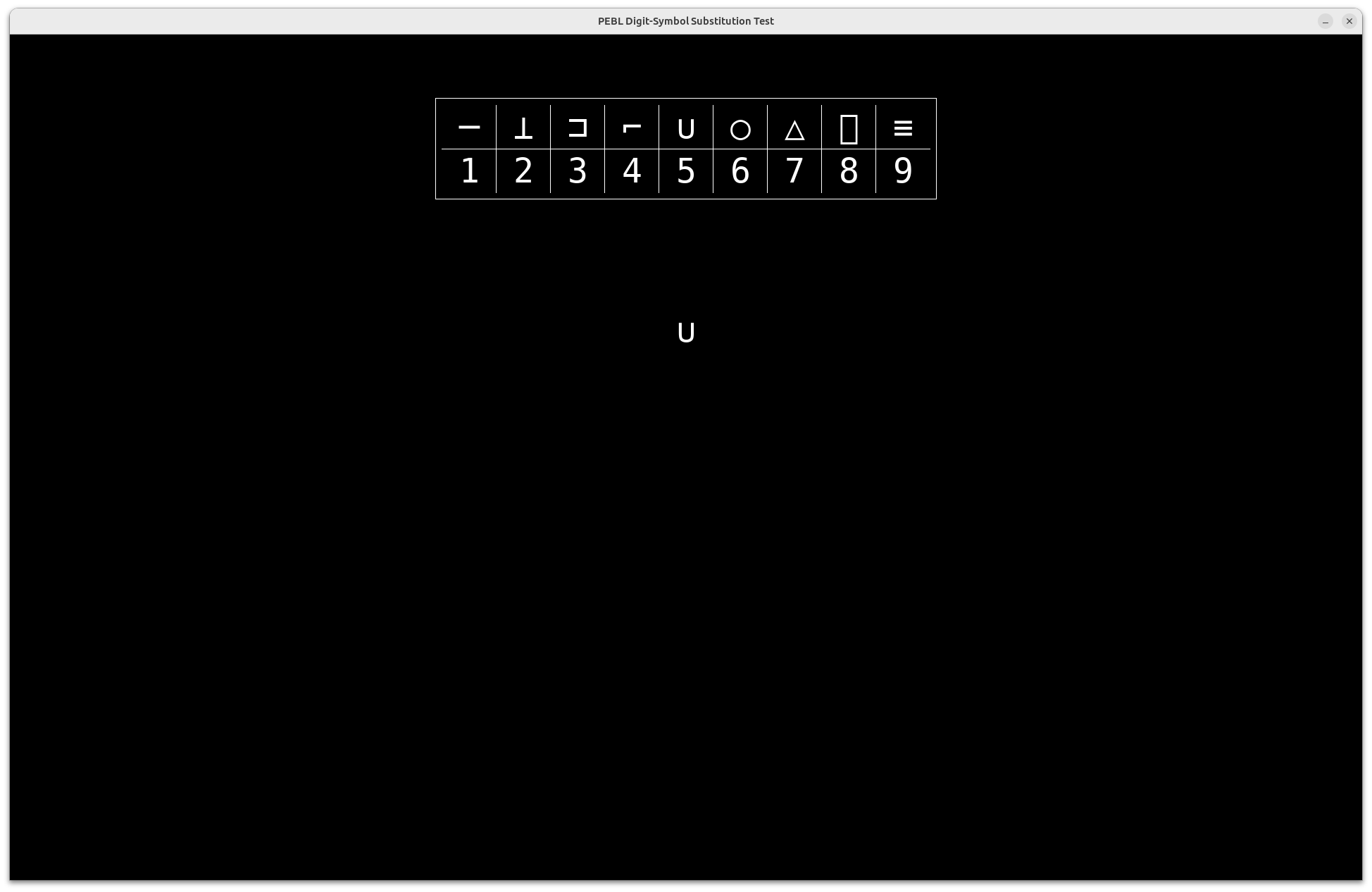
Participants view a mapping of symbols or letters paired with digits (1-9) at the top of the screen. On each trial, a stimulus appears in the center, and participants must respond with the corresponding digit (or vice versa). The task supports four directional modes: (1) symbol→digit (DSST forward), (2) digit→symbol (DSST reverse), (3) letter→digit (classic PEBL letterdigit), (4) digit→letter. Input can be via keyboard or clickable button interface (required for symbol/letter responses). This implements an enhanced version of the previous PEBL letterdigit task with expanded functionality.
- Replaces and extends the previous PEBL 'letterdigit' task with additional functionality
- Supports both letters and Unicode symbols (─ ⊥ ⊐ ⌐ ∪ ○ △ ⋈ ≡) matching clinical DSST
- Four task modes: symbol→digit, digit→symbol, letter→digit, digit→letter
- Flexible input: keyboard for digit entry, clickable interface for symbol/letter entry
- Can operate in trial-count mode (default 30 trials) or timed mode (e.g., 2 minutes)
- Clinical DSST typically uses 2-minute time limit; default here is trial-count for consistency
- Includes 7 language translations: English, Spanish, French, German, Italian, Dutch, Portuguese
- Migrated to PEBL 2.3 with Layout system, LSL markers, and UploadFile support
Test Details
digitsymboldigitsymbol.pbl🚀 Try Without Registration
Run this test immediately without creating an account. Data stays in your browser.
Researcher Access Benefits
To save configurations, upload data, use translations, track completion, and manage studies, please log in or register for an account.
Scientific Background
Original Task References:
These references describe the original task that this PEBL implementation is based on.
- Wechsler, D. (1981). WAIS-R manual: Wechsler adult intelligence scale-revised. Psychological Corporation.
- Lezak, M. D., Howieson, D. B., Bigler, E. D., & Tranel, D. (2012). Neuropsychological assessment (5th ed.). Oxford University Press.
Validation status: Not-validated
Related Tests
Data Output
Creates two data files: (1) digitsymbol-<subnum>.csv with trial-by-trial data including stimulus type, direction, response mode, accuracy and reaction time; (2) digitsymbol-summary-<subnum>.txt with overall performance statistics.
Key Variables
| Variable | Description |
|---|---|
| subnum | Participant identifier code |
| stimtype | Type of stimulus: 'letter' or 'symbol' |
| direction | Task direction: 'stimulus_to_digit' (forward DSST/letterdigit) or 'digit_to_stimulus' (reverse DSST) |
| inputmethod | Response input mode: 'keyboard' (digit keys), 'click' (mouse/touch buttons), or 'auto' (automatically selected based on direction) |
| block | Block type: 0=practice trials, 1=test trials |
| trial | Trial number within block |
| probe | The stimulus presented to participant (letter, symbol, or digit) |
| cresp | Correct response for the trial |
| resp | Participant's actual response |
| corr | Response accuracy (1=correct, 0=incorrect) |
| rt | Response time in milliseconds from stimulus onset |
Example Data
digitsymbol-example.csv Primary
Trial-by-trial data with columns: subnum (participant code), stimtype (letter/symbol), direction (stimulus_to_digit or digit_to_stimulus), inputmethod (keyboard/click/auto), block (0=practice, 1=test), trial (trial number), probe (stimulus presented), cresp (correct response), resp (participant response), corr (accuracy: 1/0), rt (response time in ms)
| subnum | stimtype | direction | inputmethod | block | trial | probe | cresp | resp | corr | rt |
|---|---|---|---|---|---|---|---|---|---|---|
| 111 | symbol | stimulus_to_digit | auto | 0 | 1 | △ | 7 | 7 | 1 | 5016 |
| 111 | symbol | stimulus_to_digit | auto | 0 | 2 | ∪ | 5 | 5 | 1 | 2949 |
| 111 | symbol | stimulus_to_digit | auto | 0 | 3 | ≡ | 9 | 9 | 1 | 1359 |
| 111 | symbol | stimulus_to_digit | auto | 1 | 1 | ∪ | 5 | 5 | 1 | 4012 |
| 111 | symbol | stimulus_to_digit | auto | 1 | 2 | ─ | 1 | 1 | 1 | 1137 |
| 111 | symbol | stimulus_to_digit | auto | 1 | 3 | ─ | 1 | 1 | 1 | 635 |
| 111 | symbol | stimulus_to_digit | auto | 1 | 4 | ∪ | 5 | 5 | 1 | 1495 |
| 111 | symbol | stimulus_to_digit | auto | 1 | 5 | ∪ | 5 | 5 | 1 | 2116 |
| 111 | symbol | stimulus_to_digit | auto | 1 | 6 | ⋈ | 8 | 8 | 1 | 1334 |
digitsymbol-summary-example.txt Summary
Text summary report containing: test metadata, participant code, stimulus-digit mapping, total trials, number correct, proportion correct, mean/median/min/max RT, RT range, standard deviation and variance
----------------------------------------------
PEBL Digit-Symbol Substitution Test (DSST)
Version 2.0
Released into public domain 2008-2026 by Shane T. Mueller, Ph.D.
Sat Jan 31 12:21:49 2026
PEBL Version 2.3
----------------------------------------------
Participant code: 111
Stimulus type: symbol
Direction: stimulus_to_digit
Input method: auto
----------------------------------------------
Mapping:
  ─ → 1
  ⊥ → 2
  ⊐ → 3
  ⌐ → 4
  ∪ → 5
  ○ → 6
  △ → 7
  ⋈ → 8
  ≡ → 9
----------------------------------------------
Number of trials: 13
Number correct: 13
Proportion correct: 1
Percent correct: 100%
Mean RT: 1848 ms
Median RT: 1652 ms
Min RT: 635 ms
Max RT: 4012 ms
RT Std Dev: 813 ms
----------------------------------------------
Sample data showing typical output format. Actual values will vary by participant.
About This Test
A processing speed and associative learning task requiring participants to match symbols with digits or letters with digits using a mapping key displayed on screen.
Category: Processing Speed
Estimated Duration: 5 minutes
Available Translations: 7 languages
Documentation Sources:
Test description file, Test implementation, Parameter schema
Documentation Status: Complete