Dual-Task Interference Test
Description
Multi-task performance test measuring dual-task interference by comparing single-task and dual-task performance on two independent response dimensions.
Measures: Dual-task processing, multi-task interference, divided attention, executive control, response coordination
executive function attention dual-task processing response selection
Ages: 18+ · Populations: adults, research, clinical, neuropsychological assessment
About This Test
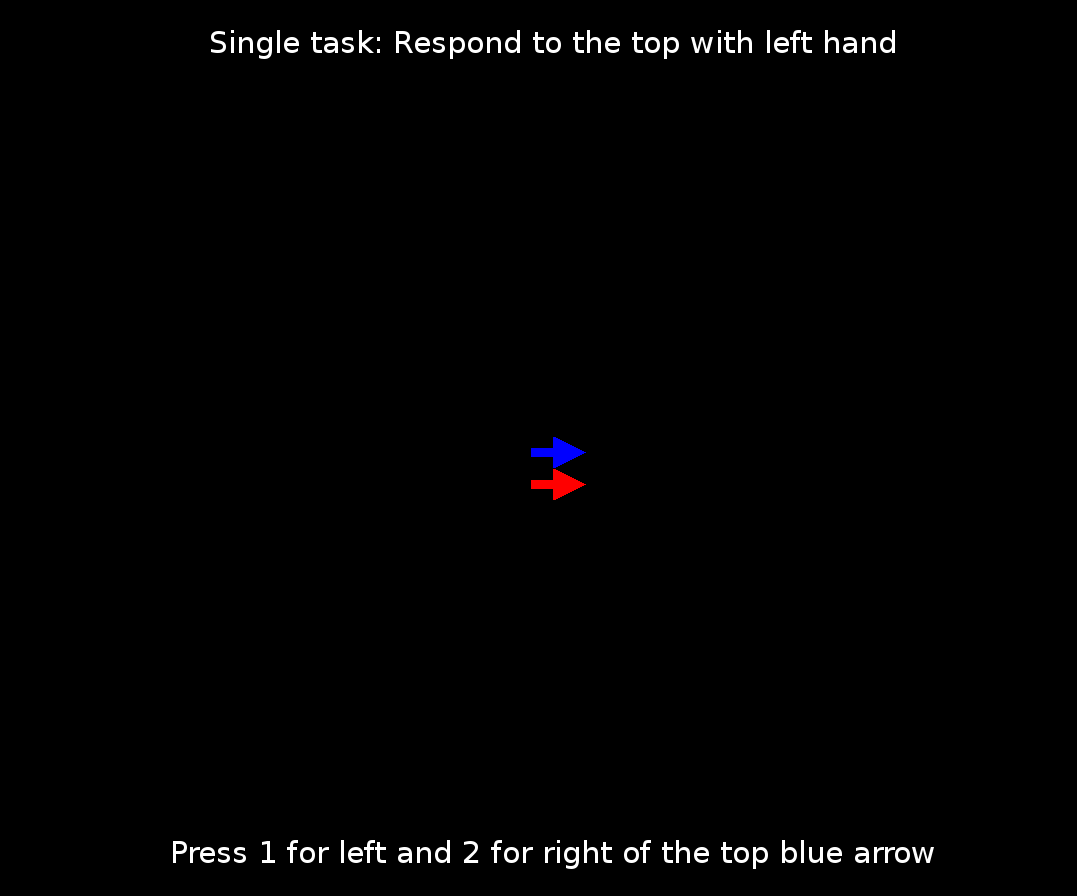
Participants respond to visual stimuli that vary along two dimensions (e.g., arrow direction and position). In single-task blocks, they respond to only one dimension. In dual-task blocks, they respond to both dimensions simultaneously using different hands. The task measures how performance on each dimension is affected by the need to process and respond to the other dimension, quantifying dual-task interference. The test supports four stimulus types: circle/square + size, arrow direction + size, double arrows (no offset), and double arrows (offset).
- Task includes three block types per round: single-task dimension 1, single-task dimension 2, and dual-task (both dimensions)
- Optional yoked mode (doyoked=1) adds fourth block type requiring simultaneous responses (within 50ms)
- Default configuration: 4 rounds = 12 blocks total (3 blocks/round) or 16 blocks if yoked mode enabled
- Event-driven response system allows responses in any order during dual-task trials
- Response keys are conditionally registered based on trial type (single vs dual)
- Supports four stimulus types with different visual dimensions and interference levels
- Semantic response mapping (DIM1A/DIM1B/DIM2A/DIM2B) for consistent data output regardless of key configuration
- Block progress indicator shows current block out of total blocks
- Adaptive header text box wraps long instructions for better readability
Test Details
dualtaskdualtask.pbl🚀 Try Without Registration
Run this test immediately without creating an account. Data stays in your browser.
Researcher Access Benefits
To save configurations, upload data, use translations, track completion, and manage studies, please log in or register for an account.
Scientific Background
PEBL-Specific References:
These studies used the PEBL version of this task.
- Mueller, S. T. & Piper, B. J. (2014). The PEBL Dual-Task Battery. Computer software. http://pebl.sourceforge.net
Validation status: Research
This PEBL implementation supports flexible stimulus types and configurable dual-task conditions. Migrated to Layout & Response System v2.3 with event-driven dual-response collection allowing responses in any order.
Data Output
Creates two output files: dualtask-data-<SUBNUM>.csv with trial-level data and dualtask-block-<SUBNUM>.txt with block-level summary statistics.
Key Variables
| Variable | Description |
|---|---|
| condition | Trial type: 1=single-task dim1, 2=single-task dim2, 3=dual-task, 4=yoked dual-task |
| stimtype | Stimulus type: 1=circle/square+size, 2=arrow direction+size, 3=double arrows (no offset), 4=double arrows (offset) |
| resp1/resp2 | Semantic response values: DIM1A/DIM1B for dimension 1, DIM2A/DIM2B for dimension 2, or NA for no response |
| corr1/corr2 | Correctness for each dimension: 1=correct, 0=incorrect |
| rt1/rt2 | Reaction times in milliseconds for each response (0 if no response) |
| tooslow | Timeout flag: 0=response within deadline, 1=timeout (>5000ms) |
Example Data
example-data.csv Primary
Trial-by-trial data with columns: subnum, stimtype, block, trialtype (PRACTICE/TEST), trial, condition (trial type 1-4), stim (stimulus number 1-4), dim1/dim2 (correct values), time0 (trial start), resp1/resp2 (semantic responses), rt1/rt2 (reaction times), corr1/corr2 (correctness), tooslow (timeout flag)
| subnum | stimtype | block | trialtype | trial | condition | stim | dim1 | dim2 | time0 | resp1 | rt1 | corr1 | resp2 | rt2 | corr2 | tooslow |
|---|---|---|---|---|---|---|---|---|---|---|---|---|---|---|---|---|
| example | 4 | 1 | PRACTICE | -25 | 1 | 2 | 0 | 1 | 8145 | DIM1A | 1661 | 0 | NA | 0 | 0 | 0 |
| example | 4 | 1 | PRACTICE | -24 | 1 | 4 | 0 | 0 | 11540 | DIM1A | 949 | 0 | NA | 0 | 0 | 0 |
| example | 4 | 1 | PRACTICE | -23 | 1 | 1 | 1 | 1 | 13800 | DIM1A | 575 | 1 | NA | 0 | 0 | 0 |
| example | 4 | 1 | PRACTICE | -22 | 1 | 3 | 1 | 0 | 15584 | DIM1A | 865 | 1 | NA | 0 | 0 | 0 |
| example | 4 | 1 | PRACTICE | -21 | 1 | 2 | 0 | 1 | 17713 | DIM1B | 424 | 1 | NA | 0 | 0 | 0 |
| example | 4 | 1 | PRACTICE | -20 | 1 | 1 | 1 | 1 | 19224 | DIM1A | 520 | 1 | NA | 0 | 0 | 0 |
| example | 4 | 1 | PRACTICE | -19 | 1 | 3 | 1 | 0 | 20701 | DIM1A | 576 | 1 | NA | 0 | 0 | 0 |
| example | 4 | 1 | PRACTICE | -18 | 1 | 4 | 0 | 0 | 22195 | DIM1B | 730 | 1 | NA | 0 | 0 | 0 |
| example | 4 | 1 | TEST | 1 | 1 | 2 | 0 | 1 | 24105 | DIM1B | 699 | 1 | NA | 0 | 0 | 0 |
example-data-block.txt Summary
Block-level summary with columns: stimtype, condition type, mean RT dimension 1, mean RT dimension 2, mean accuracy dimension 1, mean accuracy dimension 2, proportion too slow
4 1  615       0         1      0      0
4 2  0         721       0      0.96   0
4 3  569       578       1      0.96   0
4 1  464       0         1      0      0
4 2  0         513       0      0.88   0
4 3  549       579       0.92   0.96   0
4 1  510       0         0.92   0      0
4 2  0         438       0      1      0
4 3  656       665       1      1      0
4 1  490       0         0.96   0      0
4 2  0         450       0      1      0
4 3  607       612       0.96   1      0
Sample data showing typical output format. Actual values will vary by participant.
About This Test
Multi-task performance test measuring dual-task interference by comparing single-task and dual-task performance on two independent response dimensions.
Category: Executive Function
Estimated Duration: 15 minutes
Available Translations: 7 languages
Documentation Sources:
Test implementation, Parameter schema
Documentation Status: Standard