Fitts' Law Task
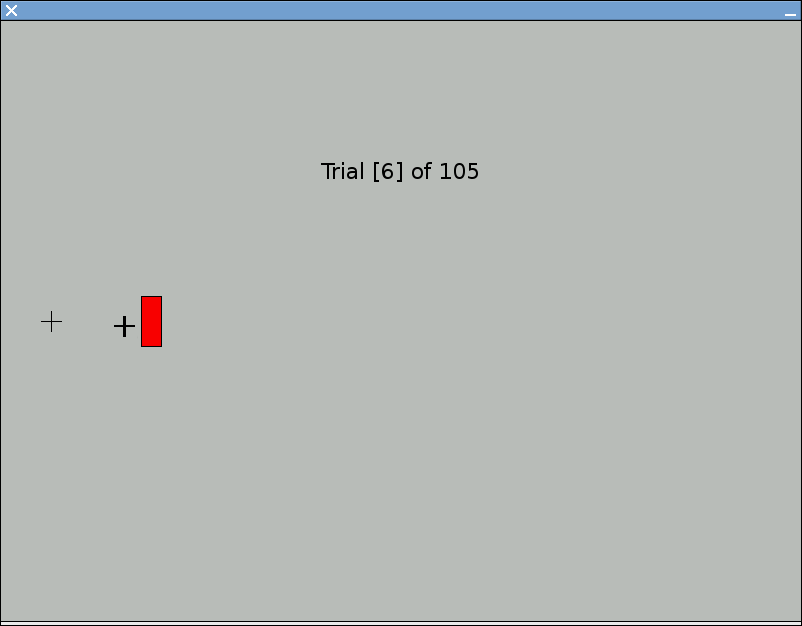
Description
Classic motor control task measuring the speed-accuracy tradeoff in rapid aimed movements. Tests the relationship between movement time, distance, and target size, following Fitts' Law (MT = a + b*log2(2D/W)).
Measures: Motor control, pointing accuracy, speed-accuracy tradeoff, psychomotor coordination
motor_control psychomotor_speed coordination
Ages: 7+ · Populations: adults, children, research, HCI, ergonomics
About This Test
Participants rapidly move the mouse cursor from a home position to rectangular targets of varying sizes and distances. Each trial begins at the home position on the left side of the screen. When ready, participants move to the target rectangle as quickly as possible. Movement time and accuracy are recorded for each trial.
- Three test modes available: OS mouse with warping (native only), graphical cursor with clicking, graphical cursor with dwelling
- Targets vary in size (10-40px) and distance (50-700px)
- Web version uses manual cursor return to home position between trials
Test Details
fittsfitts.pbl🚀 Try Without Registration
Run this test immediately without creating an account. Data stays in your browser.
Researcher Access Benefits
To save configurations, upload data, use translations, track completion, and manage studies, please log in or register for an account.
Scientific Background
Original Task References:
These references describe the original task that this PEBL implementation is based on.
- Fitts, P. M. (1954). The information capacity of the human motor system in controlling the amplitude of movement. Journal of Experimental Psychology, 47(6), 381-391.
- MacKenzie, I. S. (1992). Fitts' law as a research and design tool in human-computer interaction. Human-Computer Interaction, 7(1), 91-139.
Validation status: Validated · Psychometric data available
Known Issues
- Mouse warping disabled on web/Linux platforms - uses manual cursor return instead
Related Tests
Data Output
Creates two CSV files: trial-level summary (fitts-<subnum>.csv) with movement times and target parameters, and detailed movement log (fittspoints-<subnum>.csv) with continuous cursor position data.
Key Variables
| Variable | Description |
|---|---|
| time | Movement time from start to target acquisition (ms) |
| size | Target width (pixels) |
| pos | Target distance from home position (pixels) |
| clicks | Number of clicks required to acquire target |
About This Test
Classic motor control task measuring the speed-accuracy tradeoff in rapid aimed movements. Tests the relationship between movement time, distance, and target size, following Fitts' Law (MT = a + b*log2(2D/W)).
Category: Motor
Estimated Duration: 8 minutes
Available Translations: 1 language
Documentation Sources:
Test description file, Test implementation, Parameter schema
Documentation Status: Standard