Hick's Law Task
System Requirements
Minimum: 1024×768
Recommended: 1280×800
May be challenging for colorblind participants
Description
Demonstration of Hick's Law showing that reaction time increases logarithmically with the number of response choices
About This Test
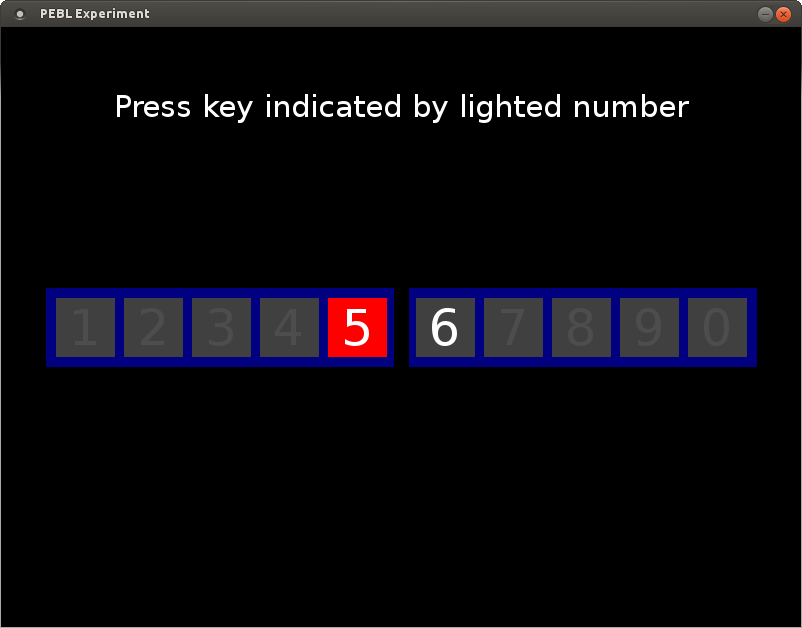
The PEBL Hick's Law Task demonstrates the fundamental relationship between the number of response alternatives and reaction time, known as Hick-Hyman Law.\n\n**Task Structure**: Participants respond by pressing number keys (1234567890) arranged across the keyboard corresponding to their fingers. On each trial, one of the valid response positions is highlighted in red, and participants must press the corresponding number key as quickly and accurately as possible.\n\n**Block Design**: The task progresses through multiple blocks with increasing response alternatives:\n- Block 1: 1 option (key 5 only)\n- Block 2: 2 options (keys 5-6)\n- Block 3: 3 options (keys 5-6-7)\n- Block 4: 4 options (keys 4-5-6-7)\n- Block 5: 6 options (keys 3-4-5-6-7-8)\n- Block 6: 8 options (keys 2-3-4-5-6-7-8-9)\n\nEach block contains 50 trials by default. Valid response keys are shown in white, while invalid keys appear in dark grey.\n\n**Response Method**: Participants place their hands on the number row with left index finger on 5 and right index finger on 6. This creates a natural finger mapping where each number corresponds to a specific finger position.\n\n**Feedback**: Optional trial-by-trial feedback ('CORRECT' / 'INCORRECT') can be provided based on task parameters.\n\n**Theoretical Basis**: Hick's Law (1952) and Hyman (1953) demonstrated that choice reaction time increases linearly with the logarithm (base 2) of the number of equiprobable alternatives: RT = a + b*log2(n), where n is the number of choices. This relationship reflects the information-processing demands of selecting among multiple response options.\n\n**Use Cases**: Educational demonstration of information processing, human factors research, baseline choice reaction time assessment, and illustration of speed-accuracy tradeoffs in decision making.
Test Details
hickshicks.pbl🚀 Try Without Registration
Run this test immediately without creating an account. Data stays in your browser.
Researcher Access Benefits
To save configurations, upload data, use translations, track completion, and manage studies, please log in or register for an account.
Scientific Background
Original Task References:
These references describe the original task that this PEBL implementation is based on.
- Hick, W. E. (1952). On the rate of gain of information. Quarterly Journal of Experimental Psychology, 4(1), 11-26.
- Hyman, R. (1953). Stimulus information as a determinant of reaction time. Journal of Experimental Psychology, 45(3), 188-196.
- Merkel, J. (1885). Die zeitlichen Verhältnisse der Willensthätigkeit. Philosophische Studien, 2, 73-127.
- Teichner, W. H., & Krebs, M. J. (1974). Laws of visual choice reaction time. Psychological Review, 81(1), 75-98.
- Proctor, R. W., & Schneider, D. W. (2018). Hick's law for choice reaction time: A review. Quarterly Journal of Experimental Psychology, 71(6), 1281-1299.
Validation status: Hick's Law is one of the most robust findings in experimental psychology, replicated across thousands of studies since the 1950s. The logarithmic relationship holds across a wide range of stimulus modalities, response modes, and participant populations. The law has been validated in auditory, visual, and tactile modalities, with manual, vocal, and oculomotor responses. Effect sizes are large and reliable.
Typical Use Cases
- Educational demonstration of information theory applied to cognition
- Baseline assessment of choice reaction time and information processing speed
- Human factors research on menu design and interface complexity
- Comparison of processing efficiency across populations or conditions
- Validation of reaction time equipment and procedures
- Investigation of speed-accuracy tradeoffs in decision making
- Study of practice effects on choice reaction time
- Assessment of cognitive slowing in clinical populations