Move-to-Target Task (Whack-a-Mole)
Description
Rapid pointing task measuring visuomotor coordination and sensorimotor adaptation with axis reversal (default configuration)
About This Test
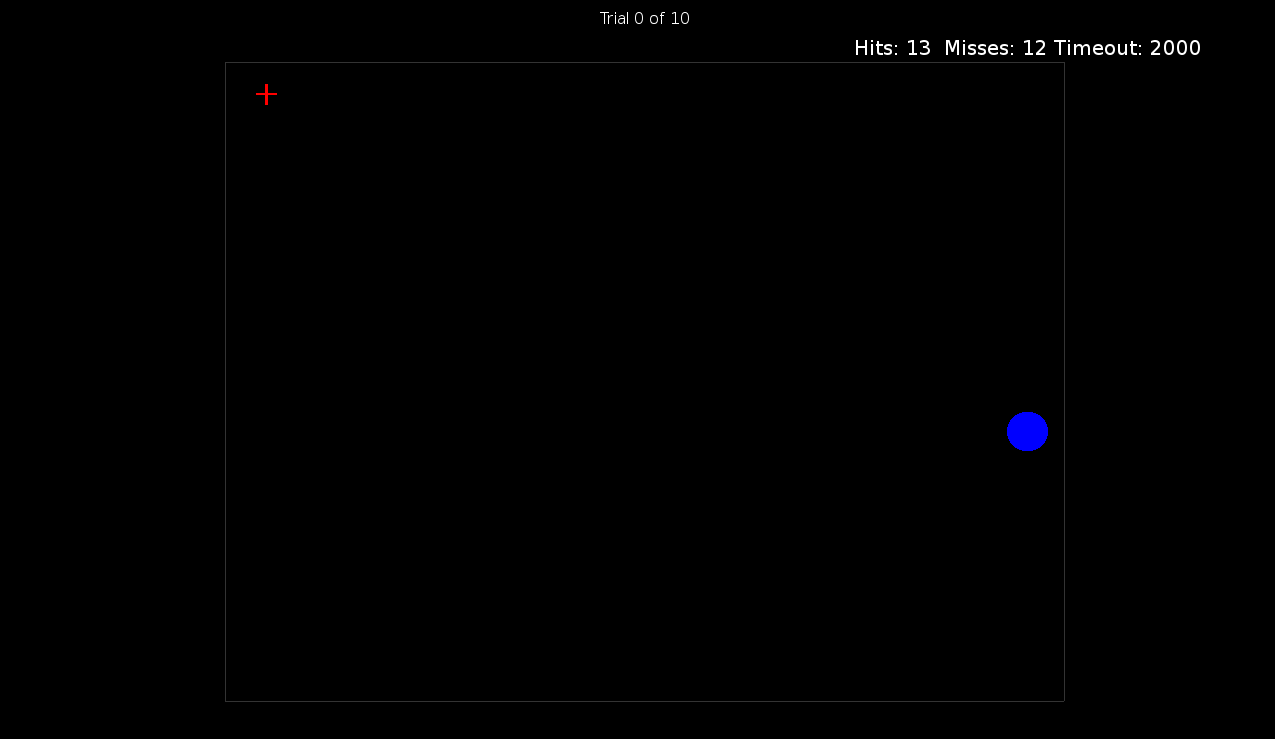
The PEBL Move-to-Target Task (also known as 'Whack-a-Mole') assesses discrete visuomotor control by requiring participants to rapidly move their cursor to and click on targets that appear at different screen locations. **Task Structure**: On each trial, a circular target appears at a random location on the screen. Participants must move their mouse cursor to the target and click on it as quickly and accurately as possible. Immediately after clicking, a new target appears at a different location. The default configuration includes 30 stimuli per trial across 10 trials (300 total target clicks). **Adaptation Manipulation**: By default, this task includes both horizontal and vertical axis reversal (xtrans=1, ytrans=-1), creating a challenging sensorimotor perturbation where moving the mouse right causes the cursor to move left, and moving down causes the cursor to move up. This tests participants' ability to adapt to novel visuomotor transformations through repeated rapid pointing movements. The axis reversal parameters can be modified to test normal mapping or single-axis reversals. **Trial Structure**: The task runs multiple trials (default 10), allowing observation of sensorimotor adaptation across repeated exposure to the reversed mapping. Each trial consists of multiple rapid pointing movements (default 30 per trial). **Related Task**: For continuous tracking movements with similar axis reversal manipulations, see the Tracking Task. The two tasks complement each other by assessing discrete vs. continuous visuomotor control under perturbation. **Administration Time**: 5-10 minutes depending on number of trials and participant speed **Theoretical Basis**: Discrete pointing tasks like move-to-target assess the rapid planning and execution of goal-directed movements. Axis reversal creates a visuomotor perturbation requiring sensorimotor recalibration through error-based learning. Performance improvements during reversed trials demonstrate adaptive learning mechanisms. **Use Cases**: Visuomotor adaptation research, sensorimotor learning studies, reaction time assessment, motor control evaluation, pointing accuracy measurement, neurological screening.
Test Details
movetotargetmovetotarget.pbl🚀 Try Without Registration
Run this test immediately without creating an account. Data stays in your browser.
Researcher Access Benefits
To save configurations, upload data, use translations, track completion, and manage studies, please log in or register for an account.
Scientific Background
Original Task References:
These references describe the original task that this PEBL implementation is based on.
- Fitts, P. M. (1954). The information capacity of the human motor system in controlling the amplitude of movement. Journal of Experimental Psychology, 47(6), 381-391.
- Krakauer, J. W., Pine, Z. M., Ghilardi, M. F., & Ghez, C. (2000). Learning of visuomotor transformations for vectorial planning of reaching trajectories. Journal of Neuroscience, 20(23), 8916-8924.
- Cunningham, H. A., & Welch, R. B. (1994). Multiple concurrent visual-motor mappings: Implications for models of adaptation. Journal of Experimental Psychology: Human Perception and Performance, 20(5), 987.
Validation status: Discrete pointing tasks are extensively validated in motor control literature. Axis reversal is a standard sensorimotor perturbation paradigm.
Typical Use Cases
- Visuomotor adaptation experiments
- Sensorimotor learning assessment
- Reaction time measurement
- Motor control evaluation
- Age-related motor changes research
- Neurological assessment (cerebellar function, Parkinson's disease)
- Hand-eye coordination testing
- Pointing accuracy measurement