Probabilistic Reversal Learning
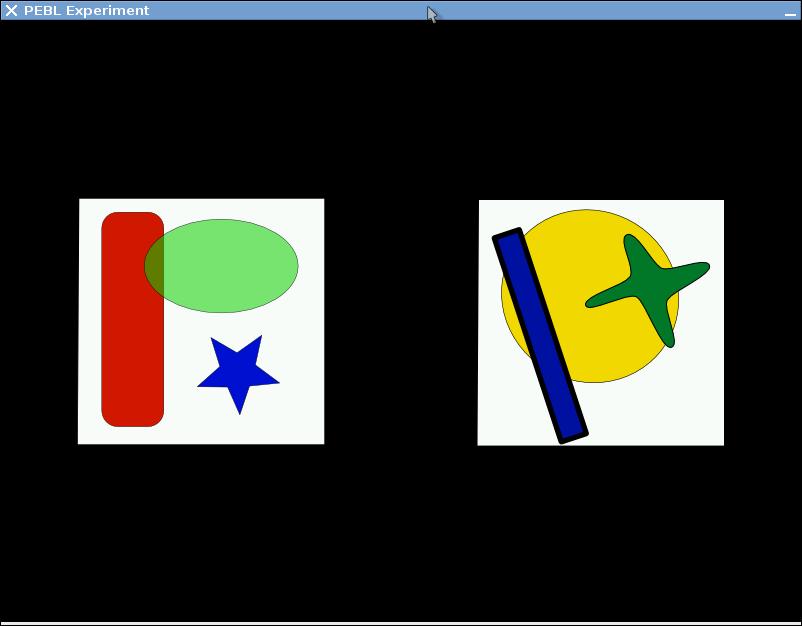
Description
A reversal learning task where participants learn stimulus-response rules that change unpredictably, with probabilistic feedback.
Measures: Cognitive flexibility, reversal learning, feedback sensitivity
Executive Function Learning
About This Test
Two abstract visual stimuli are presented on each trial. One is designated as 'correct' according to a hidden rule. Participants choose one using the left or right shift keys and receive smiley (correct) or frowny (incorrect) face feedback. Feedback is probabilistic: occasionally correct responses receive negative feedback. After a criterion number of correct responses, the rule reverses. Measures cognitive flexibility and sensitivity to feedback.
Test Details
probrevprobrev.pbl🚀 Try Without Registration
Run this test immediately without creating an account. Data stays in your browser.
Researcher Access Benefits
To save configurations, upload data, use translations, track completion, and manage studies, please log in or register for an account.
Scientific Background
Original Task References:
These references describe the original task that this PEBL implementation is based on.
- Cools, R., Clark, L., Owen, A. M., & Robbins, T. W. (2002). Defining the neural mechanisms of probabilistic reversal learning using event-related functional magnetic resonance imaging. Journal of Neuroscience, 22(11), 4563-4567.
PEBL-Specific References:
These studies used the PEBL version of this task.
- Mueller, S. T. (2011). PEBL's Probabilistic Reversal Learning Task. Computer software retrieved from http://pebl.sf.net/battery.html
Data Output
Trial-by-trial data with reversal stage, feedback validity, accuracy, and response time. The report file provides summary statistics overall and by block.
probrev-{subnum}.csv
Data Columns
| Column Name | Description |
|---|---|
| sub | Participant ID |
| block | Block number (1 to numblocks). Each block uses a new pair of stimuli. |
| stage | Reversal stage within the block. Each stage is a consecutive run of trials with a single rule; the correct stimulus reverses between stages. |
| totaltrial | Cumulative trial number across all blocks and stages |
| trial | Trial number within the current stage (resets at each reversal) |
| corrstim | Label of the currently correct stimulus for this stage (A, B, C, or D) |
| order | Which side the correct stimulus appeared on (1=left, 2=right) |
| resp | Participant's response (left or right) |
| valid | Whether feedback was valid (1) or probabilistically reversed (0). On invalid trials, correct responses receive negative feedback. |
| corrfeedback | Whether positive feedback was shown (1=smiley face, 0=frowny face). Note: this reflects feedback validity, not true correctness. |
| acc | Cumulative count of correct responses within the current stage. The stage ends when acc reaches the stage criterion. |
| corr | Whether the response was objectively correct according to the rule (1/0). A participant can be correct (corr=1) but receive negative feedback (corrfeedback=0) on invalid trials. |
| rt | Response time in milliseconds from stimulus onset |
Scoring and Interpretation
Example Data
example-data.csv Primary
Trial-by-trial probabilistic reversal learning data
| sub | block | stage | totaltrial | trial | corrstim | order | resp | valid | corrfeedback | acc | corr | rt |
|---|---|---|---|---|---|---|---|---|---|---|---|---|
| example | 1 | 1 | 1 | 1 | fig1 | 1 | left | 0 | 0 | 1 | 1 | 572 |
| example | 1 | 1 | 2 | 2 | fig1 | 2 | right | 1 | 1 | 2 | 1 | 414 |
| example | 1 | 1 | 3 | 3 | fig1 | 1 | left | 1 | 1 | 3 | 1 | 835 |
| example | 1 | 1 | 4 | 4 | fig1 | 1 | left | 0 | 0 | 4 | 1 | 359 |
| example | 1 | 1 | 5 | 5 | fig1 | 1 | left | 1 | 1 | 5 | 1 | 432 |
| example | 1 | 1 | 6 | 6 | fig1 | 2 | right | 1 | 1 | 6 | 1 | 616 |
| example | 1 | 2 | 7 | 1 | fig2 | 2 | left | 1 | 0 | 0 | 0 | 528 |
| example | 1 | 2 | 8 | 2 | fig2 | 1 | left | 0 | 0 | 1 | 1 | 768 |
| example | 1 | 2 | 9 | 3 | fig2 | 1 | left | 1 | 1 | 2 | 1 | 522 |
example-report.html Report
HTML summary report with overall and by-block performance statistics
📊 Interactive HTML Report Preview Open in new window →
Sample data showing typical output format. Actual values will vary by participant.
About This Test
A reversal learning task where participants learn stimulus-response rules that change unpredictably, with probabilistic feedback.
Category: Executive Function
Estimated Duration: 15 minutes
Available Translations: 8 languages
Documentation Status: Complete