Spatial Cueing (Posner) Task
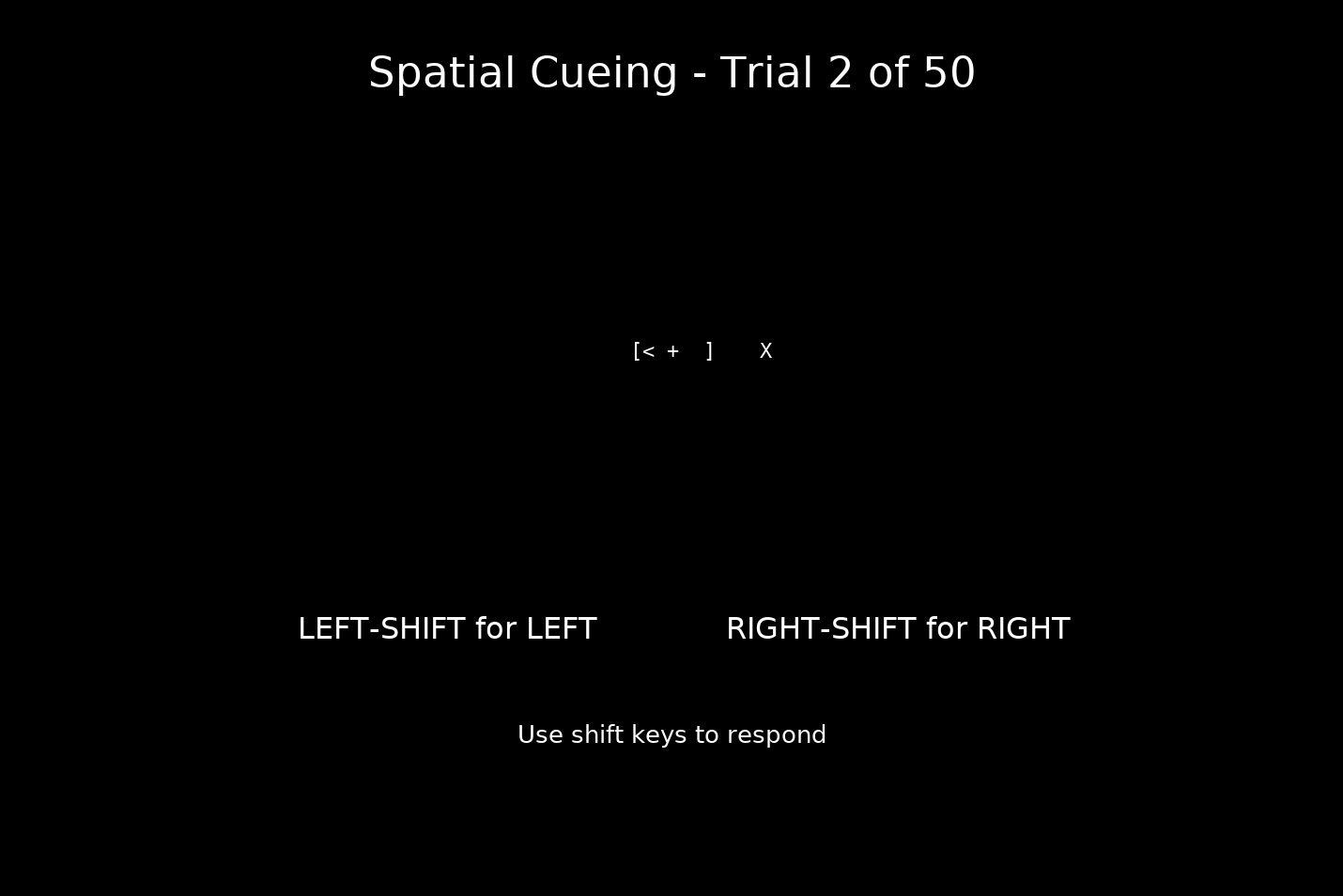
Description
A classic spatial cueing paradigm (Posner's cueing task) measuring attentional orienting via valid, invalid, and neutral cues.
Measures: Attentional orienting, cueing benefit/cost, simple reaction time
Attention
About This Test
A fixation cross appears with a directional arrow cue (left, right, or both). After a variable delay, a target X appears to the left or right. Participants respond as quickly as possible when the target appears. The arrow cue is valid (correctly predicts target location) on most trials, creating a cueing benefit for valid trials and a cost for invalid trials.
Test Details
spatialcueingspatialcueing.pbl🚀 Try Without Registration
Run this test immediately without creating an account. Data stays in your browser.
Researcher Access Benefits
To save configurations, upload data, use translations, track completion, and manage studies, please log in or register for an account.
Scientific Background
Original Task References:
These references describe the original task that this PEBL implementation is based on.
- Posner, M. I. (1980). Orienting of attention. Quarterly Journal of Experimental Psychology, 32, 3-25.
- Posner, M. I., Snyder, C. R. R., & Davidson, B. J. (1980). Attention and the detection of signals. Journal of Experimental Psychology: General, 109, 160-174.
PEBL-Specific References:
These studies used the PEBL version of this task.
- Mueller, S. T. (2011). The PEBL Spatial Cueing Task. Computer software retrieved from http://pebl.sf.net/battery.html
Data Output
The task produces a trial-by-trial CSV and a text report with RT statistics broken down by validity condition, stimulus location, and cue direction.
spatialcueing-{subnum}.csv
Example Data
example-data.csv Primary
Trial-by-trial data for each cueing trial
| subnum | trial | cue | stim | correct | delay | rt |
|---|---|---|---|---|---|---|
| 111 | 1 | 1 | 1 | 1 | 482 | 109 |
| 111 | 2 | 0 | -1 | 0 | 283 | 41728 |
| 111 | 3 | 1 | 1 | 1 | 212 | 725 |
| 111 | 4 | 1 | -1 | 0 | 93 | 414 |
| 111 | 5 | 1 | 1 | 1 | 544 | 294 |
| 111 | 6 | -1 | 1 | 0 | 688 | 696 |
| 111 | 7 | 1 | 1 | 1 | 148 | 325 |
| 111 | 8 | 1 | 1 | 1 | 209 | 340 |
| 111 | 9 | 0 | 1 | 0 | 636 | 370 |
example-report.txt Summary
Summary statistics: RT by validity (valid/neutral/invalid), by stimulus location (left/right), and by cue direction (left/neutral/right)
---------------------------------------------------
 Report for PEBL's Spatial Cueing Task
 (Posner Cueing Paradigm)
 PEBL Version 2.4
 Tue Mar 31 20:06:45 2026
 Participant Code: 111
---------------------------------------------------
RT stats by Validity Condition
Cond         N median mean sd
-----------------------
Invalid -1 10 360.5 402.4 102.062
Neutral 0 10 340.5 4485.9 12414.1
Valid   1 30 339 350.667 106.687
RT stats by Stimulus Location
Cond           N median mean sd
-----------------------
Left     -1 25 344 2003.12 8109.11
Right    1 25 354 373 120.654
RT stats by Cue Direction
Cond          N median mean sd
-----------------------
Left    -1 20 352.5 352.45 103.741
Neutral 0 10 340.5 4485.9 12414.1
Right   1 20 357.5 374.75 110.789
------------------------------------------------
Sample data showing typical output format. Actual values will vary by participant.
About This Test
A classic spatial cueing paradigm (Posner's cueing task) measuring attentional orienting via valid, invalid, and neutral cues.
Category: Attention
Estimated Duration: 8 minutes
Available Translations: 7 languages
Documentation Status: Complete