Symmetry Span Task
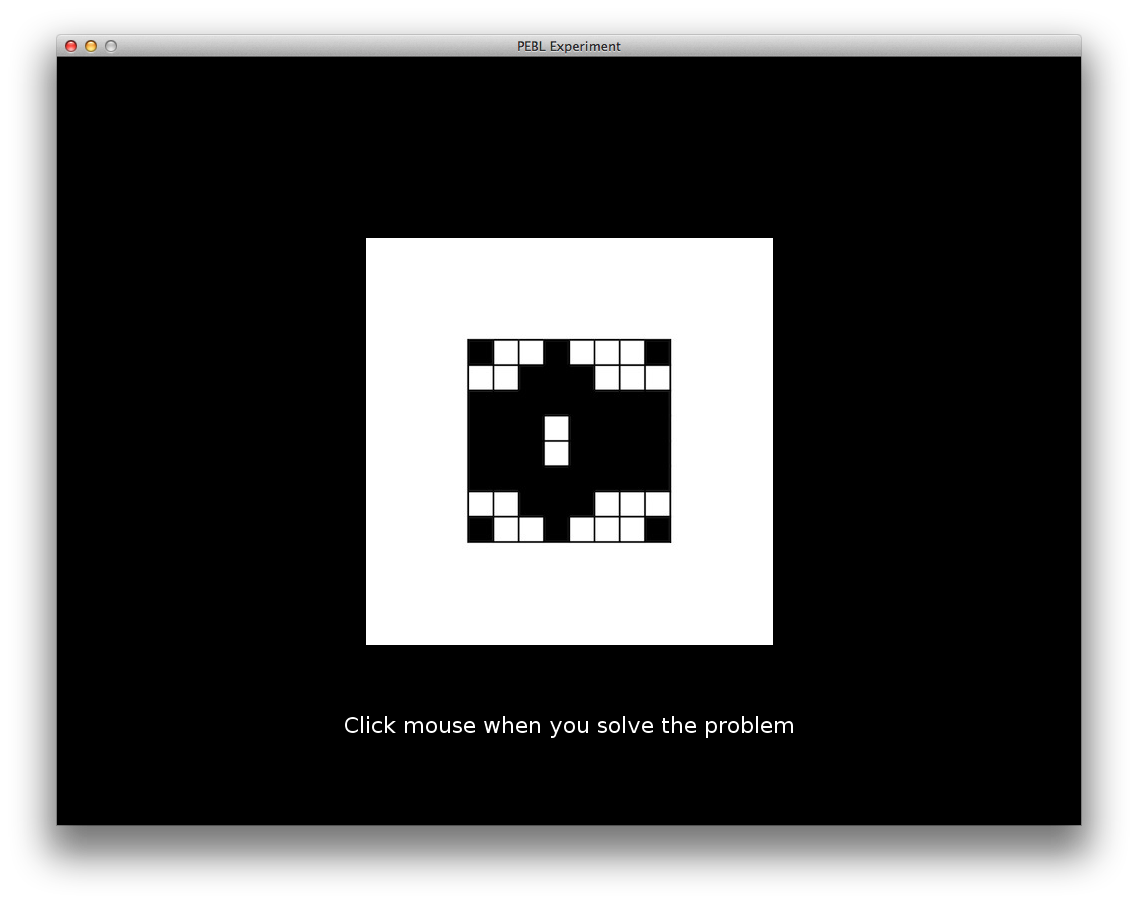
Description
Visuospatial working memory span task requiring participants to remember spatial locations while making symmetry judgments.
Measures: Visuospatial working memory span, executive function, dual-task processing, symmetry processing, spatial memory
working memory visuospatial processing executive function dual-task processing spatial memory
Ages: 18+ · Populations: adults, research, clinical
About This Test
Participants judge whether 8x8 grid patterns are vertically symmetrical (True/False), then see a red square flash in one cell of a 4x4 grid to remember. After a series of symmetry-square pairs (set size 2-5), they recall the square locations in order by clicking on the grid. The task includes practice blocks for spatial recall only, symmetry judgments only, and combined trials. Symmetry performance is monitored and participants must maintain 85% accuracy on symmetry judgments to ensure divided attention. If threshold is not met, participants may repeat practice with feedback. The main test consists of sets of 3 trials at each set size (2, 3, 4, 5) in random order.
- Task follows Kane et al. (2004) methodology with 2-5 square set sizes
- Symmetry accuracy threshold (default 85%) enforced to ensure divided attention
- Adaptive symmetry timeout calculated from practice: mean + 2.5*SD with 1000ms minimum
- Practice includes: spatial recall only (3 trials at size 2), symmetry only (15 trials), combined (3 trials at size 2)
- Main test: 12 trials total with set sizes [2,3,4,5] × 3 repetitions in randomized order
- Symmetry problems use 8×8 grids loaded from images in img/ directory
- Spatial recall uses 4×4 grid with red squares that flash for 650ms each
- Custom mouse-clickable 4×4 grid for recall with Clear/Del/Empty/Done buttons
- Real-time accuracy display shown in test phase (top right corner)
- Trial counter shows current trial / total trials during test phase
- Supports LSL markers for electrophysiological recording integration
- Supports online upload via InitializeUpload() and UploadFile()
- Uses HTML-lite formatted text with adaptive textboxes for instructions
- Includes 7 translations (en, es, de, pt, fr, nl, it) via JSON translation system
- Practice can be repeated once if symmetry threshold not met (allowsecondchance=1)
- Creates HTML report summarizing performance metrics and set size analysis
Test Details
symmetryspansymmetryspan.pbl🚀 Try Without Registration
Run this test immediately without creating an account. Data stays in your browser.
Researcher Access Benefits
To save configurations, upload data, use translations, track completion, and manage studies, please log in or register for an account.
Scientific Background
Original Task References:
These references describe the original task that this PEBL implementation is based on.
- Kane, M. J., Hambrick, D. Z., Tuholski, S. W., Wilhelm, O., Payne, T. W., & Engle, R. W. (2004). The generality of working memory capacity: A latent-variable approach to verbal and visuospatial memory span and reasoning. Journal of Experimental Psychology: General, 133(2), 189-217.
- Unsworth, N., Redick, T. S., Heitz, R. P., Broadway, J. M., & Engle, R. W. (2009). Complex working memory span tasks and higher-order cognition: A latent-variable analysis of the relationship between processing and storage. Memory, 17(6), 635-654.
Validation status: Validated · Psychometric data available · Normative data available
Originally developed by D. L. Hegarty, with modifications by the PEBL Project. Licensed GPLv3. This implementation follows the Kane et al. (2004) symmetry span procedure. The task has been extensively validated as a measure of visuospatial working memory capacity and executive function. Migrated to Layout & Response System v2.3 with adaptive formatted textboxes, LSL integration, and online upload support. The symmetry span task is structurally similar to operation span but taxes visuospatial rather than verbal working memory resources.
Related Tests
Data Output
Creates three files: (1) symspan-<SUBNUM>.csv with trial-level recall data, (2) symspan-sym-<SUBNUM>.csv with individual symmetry judgment responses and reaction times, and (3) symmetryspan-report-<SUBNUM>.html with summary statistics and visualizations.
Key Variables
| Variable | Description |
|---|---|
| memcorr | Primary DV for span file: proportion correct spatial recall = locations recalled correctly divided by set size (length) |
| length | Set size: number of spatial locations to recall in this trial (2-5 for test trials, 2 for practice) |
| probtime | Symmetry judgment presentation timeout in ms, calculated adaptively from practice block (mean RT + 2.5*SD, minimum 1000ms) |
| memtime | Red-square presentation duration in ms (fixed, 650ms per square) |
| time | Average response time per square in ms. Not a primary dependent variable. |
| stim | Comma-separated list of target square positions presented (1-16, reading order left-to-right, top-to-bottom in 4x4 grid) |
| resp | Comma-separated list of recalled square positions (1-16, reading order) |
| symprestime | Symmetry judgment timeout in ms (symmetry file): same adaptive value as probtime in span file |
| image | Filename of 8x8 grid symmetry image presented (symmetry file only) |
| corrans | Correct answer for symmetry judgment: 1=symmetric, 0=asymmetric (symmetry file only) |
| distcorr | Proportion of symmetry judgments answered correctly in this trial (numcorrdist / totnumdist) |
| runningcorrect | Cumulative correct symmetry responses across all trials to this point. Not a primary dependent variable. |
| runningtotal | Cumulative total symmetry problems across all trials to this point. Not a primary dependent variable. |
| rt | Reaction time in ms for symmetry True/False response (symmetry file only) |
Column meanings confirmed with original author D.L. Hegarty (2026). Practice trials numbered sequentially starting from trial 1 (not labeled separately from test trials). Column structure parallels ospan with symmetry-specific fields in secondary file.
About This Test
Visuospatial working memory span task requiring participants to remember spatial locations while making symmetry judgments.
Category: Memory
Estimated Duration: 15 minutes
Available Translations: 7 languages
Documentation Sources:
Test description file, Test implementation, Parameter schema
Documentation Status: Standard
Originally developed by D.L. Hegarty & Dufflecoat Enterprises (2014), with modifications by the PEBL Project. License: GPLv3.