Two-Column Addition Test
Description
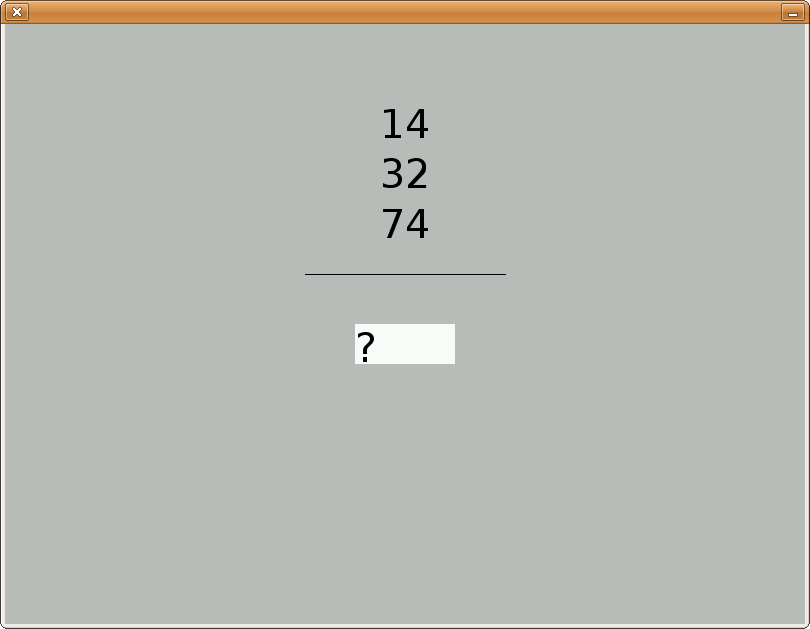
Mental arithmetic task requiring rapid addition of three two-digit numbers presented vertically
Measures: Mental calculation ability, arithmetic processing speed, working memory for numerical information, and performance under time constraints
arithmetic mental_calculation processing_speed working_memory numerical_processing
Ages: 7+ · Populations: adults, adolescents, children (with adequate arithmetic skills), research participants, cognitive assessment batteries
About This Test
The Two-Column Addition Test assesses mental arithmetic ability by requiring participants to rapidly add three two-digit numbers. **Procedure**: Three two-digit numbers (ranging from 11-99, no zeros) are presented vertically in columnar format. Participants must mentally calculate the sum and enter their answer using the keyboard number keys. The answer must be entered left-to-right (hundreds digit first, then tens, then ones if applicable). Participants can use backspace to correct mistakes before pressing Enter to confirm. **Timing**: Each problem has a 15-second time limit. If participants fail to respond within this time, a buzzer sounds and the next problem appears. Practice trials provide feedback on accuracy and response time; test trials do not. **Phases**: 1. **Practice Phase** (10 trials by default): Problems with feedback showing correct/incorrect and response time 2. **Test Phase** (45 trials by default): Problems without feedback **Scoring**: The test records accuracy, response time to first keypress, completion time, number of keystrokes, and whether timeout occurred. This provides measures of both speed and accuracy in mental arithmetic.
- Part of the UTC-PAB (Unified Tri-Services Cognitive Performance Assessment Battery) as Test 4
- Numbers are randomly generated (11-99 excluding any with 0 digits)
- Buzzer sound (buzz500ms.ogg) plays on timeout
- Instructions updated for web deployment with HTML-lite formatting and AdaptiveTextBox
- Requires numeric keyboard input - not suitable for pure touch interfaces
- Default timeout of 15 seconds is configurable via parameters
- Practice trials provide accuracy feedback and completion time; test trials do not
- LSL support added: markers for block start/end, stimulus onset, response submission/timeout, and trial accuracy
- Available in 7 languages: English, German, Spanish, French, Italian, Dutch, Portuguese
Test Details
twocoladdtwocol.pbl🚀 Try Without Registration
Run this test immediately without creating an account. Data stays in your browser.
Researcher Access Benefits
To save configurations, upload data, use translations, track completion, and manage studies, please log in or register for an account.
Scientific Background
Original Task References:
These references describe the original task that this PEBL implementation is based on.
- Wilkinson, R. T., & Houghton, D. (1975). Field test of arousal: A portable reaction timer with data storage. Human Factors, 17(4), 335-342.
PEBL-Specific References:
These studies used the PEBL version of this task.
- Mueller, S. T. (2011). The PEBL Two-column addition test. Computer software retrieved from http://pebl.sf.net.
Validation status: Not-validated
Typical Use Cases
- Cognitive ability assessment batteries (UTC-PAB Test 4)
- Processing speed evaluation
- Working memory capacity assessment
- Educational achievement testing
- Neuropsychological assessment
- Cognitive decline screening
- Research on numerical cognition