Global-Local Processing Task
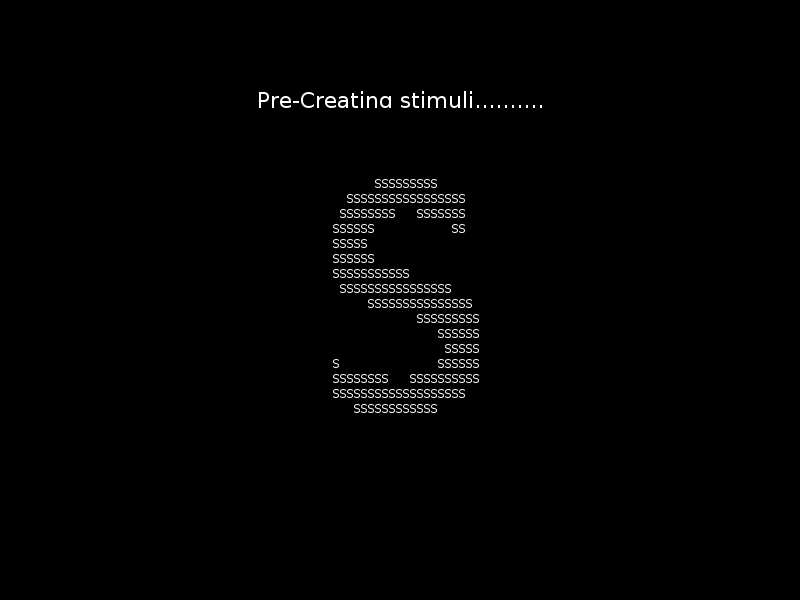
Description
Navon hierarchical letter task examining global vs. local visual processing and attentional focus. Participants respond to either small letters or large letter shapes composed of smaller letters, testing the ability to selectively attend to different levels of hierarchical visual stimuli.
Measures: Visual attention, global vs. local processing, hierarchical stimulus processing, selective attention, cognitive interference, global precedence effect
attention visual processing perception
Ages: 7+ · Populations: adults, children, research, cross-cultural
About This Test
Participants view large letters (global level) composed of smaller letters (local level) and respond to target letters at either the global or local level depending on the block condition. For example, a large 'H' might be made of small 'S' letters. In global attention blocks, participants respond to the large letter shape; in local attention blocks, they respond to the small component letters. The task includes congruent trials (same letter at both levels), incongruent trials (different letters), and conditions with and without spatial scatter of the local elements. This design measures selective attention, the global precedence effect, and interference between processing levels.
- Task includes multiple stimulus sets with different letter combinations
- Supports 7 languages: English, German, Spanish, French, Croatian, Italian, Dutch, Lithuanian, Portuguese, and Chinese
- Uses Layout system for responsive positioning and modern response handling
- Includes conditions with and without spatial scatter to manipulate grouping cues
- Provides detailed trial-by-trial feedback and block summaries
Test Details
globallocalgloballocal.pbl🚀 Try Without Registration
Run this test immediately without creating an account. Data stays in your browser.
Researcher Access Benefits
To save configurations, upload data, use translations, track completion, and manage studies, please log in or register for an account.
Scientific Background
Original Task References:
These references describe the original task that this PEBL implementation is based on.
- Navon, D. (1977). Forest before trees: The precedence of global features in visual perception. Cognitive Psychology, 9(3), 353-383.
- McKone, E., Davies, A. A., Fernando, D., Aalders, R., Leung, H., Wickramariyaratne, T., & Platow, M. J. (2010). Asia has the global advantage: Race and visual attention. Vision research, 50(16), 1540-1549.
- Kimchi, R. (1992). Primacy of wholistic processing and global/local paradigm: a critical review. Psychological Bulletin, 112(1), 24-38.
Validation status: Validated · Psychometric data available
Related Tests
Data Output
Creates detailed trial-by-trial CSV file and summary statistics file. Records stimulus configuration, congruency, response times, accuracy, and performance by block and condition.
Key Variables
| Variable | Description |
|---|---|
| target_level | Whether participant responds to global (large letter) or local (small letters) level |
| congruent | Whether global and local letters match (1) or differ (0) |
| scatter | Whether local elements are spatially scattered (1) or tightly grouped (0) |
| rt | Reaction time in milliseconds from stimulus onset to response |
| correct | Response accuracy: 1=correct, 0=incorrect |
About This Test
Navon hierarchical letter task examining global vs. local visual processing and attentional focus. Participants respond to either small letters or large letter shapes composed of smaller letters, testing the ability to selectively attend to different levels of hierarchical visual stimuli.
Category: Attention
Estimated Duration: 15 minutes
Available Translations: 7 languages
Documentation Sources:
Test description file, Test implementation, Parameter schema
Documentation Status: Standard