Number Stroop Task
System Requirements
Minimum: 800×600
Recommended: 1280×800
Description
A numerical variant of the Stroop task measuring interference between enumeration and digit reading, requiring participants to report quantity while ignoring digit identity.
Measures: Executive function, inhibitory control, enumeration speed, numerical processing, and the ability to suppress automatic digit reading in favor of quantity judgment.
Executive Function Attention Processing Speed
Ages: 7+ · Populations: adults, children, research, clinical, neuropsychological-assessment
About This Test
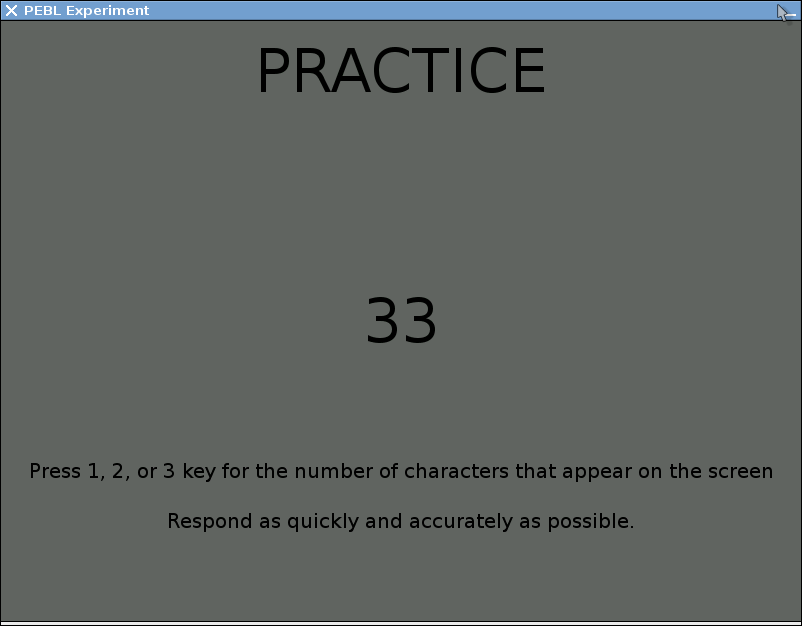
Modeled after Hernandez et al. (2010). Participants indicate how many items (1-3) appear on screen by pressing keys 1, 2, or 3, regardless of item identity. Stimuli include: (a) neutral letters (Z, MM, GGG), (b) congruent digits matching quantity (1, 22, 333), or (c) incongruent digits mismatching quantity (2, 33, 111). Each trial begins with a fixation cross (1000ms) followed by stimulus presentation (2000ms timeout). The task includes practice with feedback, followed by two test blocks without feedback. Keyboard response mode is standard.
- Numerical Stroop variant based on Hernandez et al. (2010) methodology
- Practice block (24 trials) with feedback, followed by two test blocks (84 trials each) without feedback
- Tests enumeration-digit interference rather than color-word interference
- Includes 9 language translations: English, German, Spanish, French, Italian, Korean, Dutch, Portuguese, Turkish
- Updated to PEBL 2.3 with Layout system, block counters, and version 1.0 (2026)
- The CSV header contains 'response' twice - column 2 shows response mode, column 9 shows actual response
Test Details
stroop-numbernumber-stroop.pbl🚀 Try Without Registration
Run this test immediately without creating an account. Data stays in your browser.
Researcher Access Benefits
To save configurations, upload data, use translations, track completion, and manage studies, please log in or register for an account.
Scientific Background
Original Task References:
These references describe the original task that this PEBL implementation is based on.
- Hernandez, A., Caño, A., & Costa, A. (2010). The role of cognitive control in bilingual language switching. Cognitive Psychology, 61(1), 1-24.
- Pavese, A., & Umiltà, C. (1998). Symbolic distance between numerosity and identity modulates Stroop interference. Journal of Experimental Psychology: Human Perception and Performance, 24(5), 1535-1545.
Validation status: Preliminary
Related Tests
Data Output
Creates multiple data files: (1) numstroop-keyboard-<subnum>.csv with trial-by-trial data, (2) numstroop-keyboard-summary-<subnum>.txt with performance statistics, (3) numstroop-keyboard-pooled.csv combining all participants, and (4) numstroop-sumall.csv with summary statistics.
Key Variables
| Variable | Description |
|---|---|
| subnum | Participant identifier code |
| block | Block number (0=practice, 1=first test block, 2=second test block) |
| trial | Trial number within block |
| stim | The stimulus displayed (e.g., '111', 'ZZZ', '2') |
| cond | Trial type: C=congruent, I=incongruent, N=neutral |
| responded | Whether participant responded (1=yes, 0=timeout) |
| response | Participant's response (1-3 for quantity) |
| correct | Response accuracy (1=correct, 0=incorrect) |
| rt | Response time in milliseconds |
About This Test
A numerical variant of the Stroop task measuring interference between enumeration and digit reading, requiring participants to report quantity while ignoring digit identity.
Category: Executive Function
Estimated Duration: 10 minutes
Available Translations: 9 languages
Documentation Sources:
Test description file, Test implementation, Parameter schema
Documentation Status: Complete